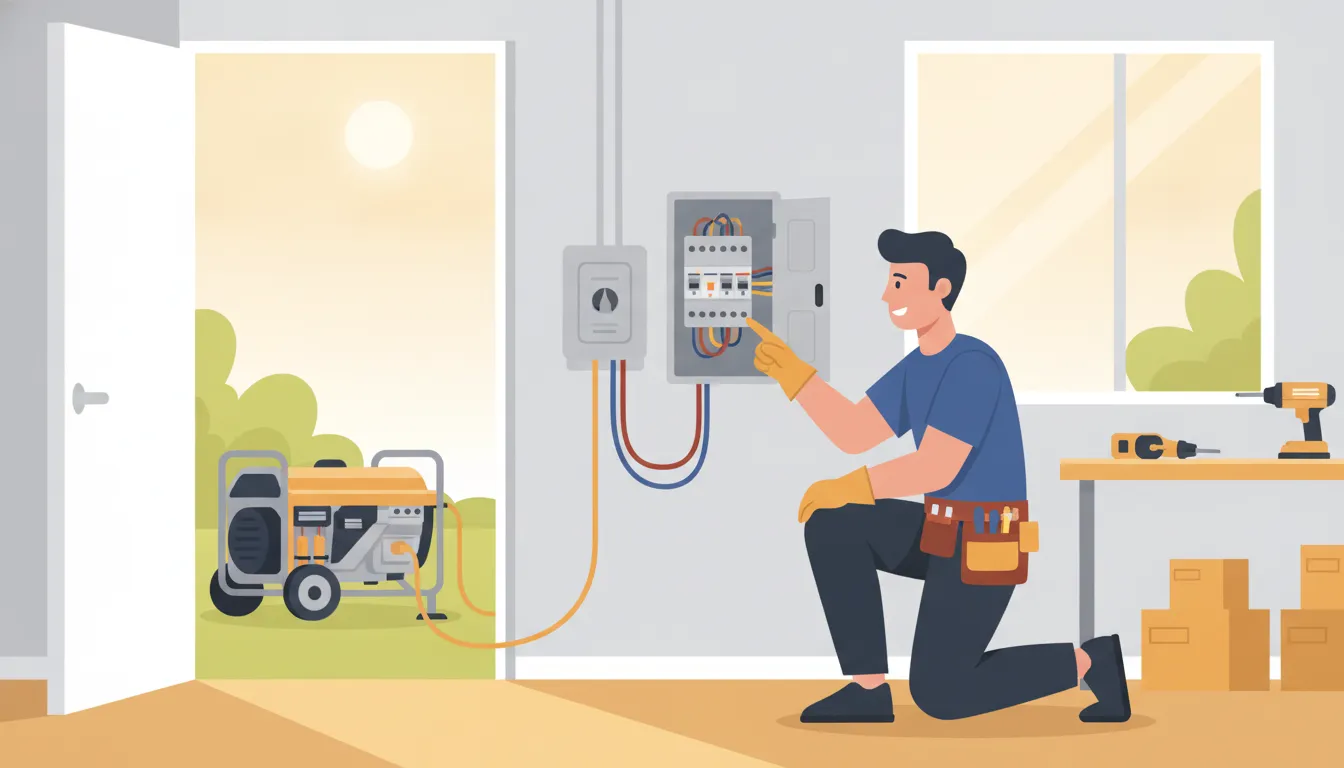
When a storm knocks out power, a portable generator can keep essential parts of your home running. Connecting it safely takes more than plugging in the machine. The generator and transfer switch must match the electrical panel, intended circuits, and manufacturer requirements.
Automatic transfer switch installation for portable generator systems creates a controlled connection. It detects a utility outage and transfers compatible loads to generator power. It also isolates the generator from the utility supply. This helps prevent dangerous backfeed.
Equipment and a professional load evaluation determine the supported circuits.
Models, panels, installation methods, and local permit requirements vary. Do not improvise panel connections. Do not assume a portable generator is automatically compatible with an automatic switch. First, understand what the switch does.
Then learn how it manages changeover between utility and generator power.
What Does an Automatic Transfer Switch Do for a Portable Generator?
An automatic transfer switch, or ATS, manages the change between utility electricity and compatible generator power. Its most important job is keeping the generator separated from the utility system during backup operation. That separation protects the generator.
It also helps prevent electrical energy from traveling onto utility lines. Such energy could injure or kill utility workers. The Generac transfer-switch manual describes this isolation as a core installation requirement.
Schedule generator installation and repair to discuss a safe connection for your portable generator.
How does the switch respond to an outage?
An automatic switch monitors the utility supply. When it detects an outage, it can transfer designated loads to compatible generator power. When utility service returns, it transfers those loads back to the normal source.
The sequence prevents both sources from feeding the same circuits at once.
This differs from plugging a generator into a household receptacle or using an improvised connection. Those methods do not provide the controlled isolation a transfer switch is intended to provide.
The exact behavior depends on the generator, switch, panel, and installation design. A portable generator is not automatically equivalent to a permanently installed standby generator. An ATS must be compatible with the equipment it controls.
Manufacturer instructions and a professional evaluation matter before assuming that a portable unit can operate automatically.
Does an ATS power every circuit in the house?
The answer depends on the generator's capacity and selected backup circuits. Many portable-generator arrangements serve designated circuits rather than the entire home. Priorities may include refrigeration, lighting, selected outlets, or other essential equipment.
Backup output may not be sufficient for every household circuit.
The system therefore needs a deliberate load plan. See the transfer-switch overview from Anker SOLIX for the distinction between selected-circuit and broader backup arrangements.
A properly designed system makes the power source visible and controllable. The switch directs power safely. It does not increase the generator's output. A qualified electrician should evaluate the equipment instructions, panel connection, grounding, load coverage, and installation method.
Generac guidance states that installation, inspection, and testing should be performed by competent, qualified electricians familiar with the equipment and requirements.
How Does Automatic Transfer Switch Installation for a Portable Generator Work?
When an outage leaves you deciding which parts of the home need backup power, installation starts with an evaluation. It is not a wiring shortcut. An electrician reviews the portable generator, transfer equipment, panel, intended loads, grounding, installation method, and manufacturer requirements.
These details determine whether the equipment can work as a safe system.
1. The generator and backup loads are evaluated
The first planning question is how much power the generator can provide. The electrician compares its running watts and starting watts with the circuits you want to support. Essential loads might include refrigeration, selected lighting, or communication equipment.
Other priority circuits may also be considered.
A portable generator should not be assumed to power the entire home because the panel is large.
This review helps determine whether the proposed automatic transfer switch suits the generator's output and configuration. Compatibility depends on more than a switch name or amp rating.
The generator, switch, panel, load coverage, and manufacturer instructions all have to align.
Consult the equipment manuals and arrange a professional evaluation before purchasing components.
2. The panel and generator inlet location are planned
Transfer equipment is commonly installed near the main electrical panel. The best arrangement depends on the home's layout and selected circuits. The electrician plans the connection route and identifies a suitable outdoor location for the generator inlet box.
That inlet should have a proper weather-rated cover. Its position must also support safe portable-generator operation.
The connection also requires a properly rated power cord between the portable generator and inlet box. Equipment and location must be planned together.
Do not rely on an improvised extension, unsafe adapter, or connection that could send generator power where it should not go.
3. The equipment is installed, tested, and explained
The work involves high-voltage electrical connections. A qualified electrician completes it according to the equipment manufacturer's instructions and applicable requirements.
The process may include mounting the switch, preparing the panel connection, installing the inlet, configuring selected loads, and addressing grounding and safety features. The sequence varies with the generator, panel, switch, and local requirements.
After installation, testing should cover utility mode, generator mode, breaker operation, load behavior, and safety interlocks. A professional service process should include an assessment, an upfront quote, code-aligned execution, safety checks, and customer education.
That final explanation matters. You need to know which loads are backed up, how the system operates, and what the manufacturer requires for future use. For help planning a safe connection, review generator installation and repair with a qualified electrical professional.
Is Your Portable Generator Compatible With an Automatic Transfer Switch?
A portable generator is not automatically compatible with every automatic transfer switch. The right combination depends on the generator's electrical output, the switch design, your panel, and the circuits you want to support.
Both manufacturers' requirements also matter. A professional evaluation should consider all of those parts together, rather than treating the switch as a universal adapter.
Start with the generator's output and phase. Some transfer-switch equipment is designed for a single-phase system and a 120/240VAC load or subpanel. That does not make every portable generator suitable.
The electrician also compares running watts with the starting watts required by motor-driven equipment. Refrigerators, pumps, and air-conditioning components can have different demands. A generator may appear large enough during normal operation but struggle when several loads start together.
The intended coverage matters just as much as the generator label. A selected-circuit installation may support only essential loads, while a whole-home plan requires a different evaluation of service equipment, switch rating, load management, and available generator capacity.
| Planning approach | What it may support | What must be evaluated |
|---|---|---|
| Essential-circuit backup | Selected circuits such as a refrigerator, lights, router, selected outlets, or other priority equipment. | Generator running and starting watts, circuit selection, panel connection, phase, and compatible switch rating. |
| Whole-home or service-rated planning | More circuits, potentially including broader household operation when the equipment and load plan support it. | Service equipment, total demand, load management, generator capacity, manufacturer requirements, and applicable switch rating. |
A 200-amp transfer switch is not a default requirement for a portable generator. It is appropriate only for some whole-home or service-rated arrangements.
Essential-circuit backup often uses smaller equipment, depending on the panel and circuits being transferred. A higher-rated switch does not create more generator capacity. It also cannot guarantee that every household circuit can operate together.
Manufacturer instructions are another compatibility checkpoint. The generator, automatic transfer switch, inlet equipment, and panel arrangement must be approved and installed as required.
An electrician should verify grounding, connection method, interlocks, isolation features, and local requirements. Do not wire a transfer switch into a panel, modify safety devices, or improvise a generator connection. For a complete evaluation, see generator installation and repair services.
What Safety Risks Should You Plan For Before Installation?
The most serious risk is an unsafe connection between generator power and utility power. A transfer switch must isolate the generator from the utility distribution system while it operates.
Without isolation, electricity can backfeed into the grid. This can damage equipment and create a potentially fatal hazard for utility workers.
Installation should be handled by a qualified electrician, not improvised with a homemade connection or a so-called suicide cord. Generac's transfer-switch guidance also emphasizes professional installation, inspection, and testing.
Carbon monoxide requires careful generator placement
Electrical safety is only part of the planning. Portable generators produce carbon monoxide. This gas is colorless and odorless, so people may not detect it before exposure becomes dangerous.
The U.S. Consumer Product Safety Commission says to operate a portable generator outdoors, at least 20 feet from a home or building. Direct exhaust away from windows, doors, and vents. Never operate one inside a home, garage, basement, crawlspace, shed, or another enclosed space.
Review the guidance on safe generator placement before installation. Place working carbon monoxide alarms on every level of the home and outside sleeping areas. The CPSC also notes that some portable generators include carbon monoxide shut-off features, which can provide an additional safety measure but should not replace correct placement and ventilation.
Weather, codes, and maintenance still matter
Rain and storms often create the need for backup power, but wet conditions can increase shock hazards. Follow the generator and transfer-switch manufacturers' instructions for wet-weather operation, covers, clearances, grounding, and other equipment-specific requirements. Do not assume that a weather-resistant inlet makes every operating condition safe.
Local electrical and building requirements can vary by jurisdiction and project scope. Consult the local authority having jurisdiction, or AHJ, about applicable codes, permits, and inspections.
After installation, regular checks and maintenance help ensure the generator works properly. A professional evaluation can confirm that the generator, switch, panel, grounding, connection method, and intended loads work together safely.
Do You Need a Permit for a Portable Generator Transfer Switch?
There is no single permit rule for every portable generator transfer switch installation. Requirements can vary by jurisdiction and project scope. A selected-circuit connection may be reviewed differently from work that changes service equipment, adds a panel, or affects more of the home's system. Transfer-switch guidance also states that manufacturer instructions do not replace local, state, or national electrical and building codes. Consult the local authority having jurisdiction.
Before work begins, ask the electrician to identify the authority having jurisdiction for your address. Confirm whether a permit is required. You can also contact the local building or electrical department.
Ask what documents are needed, who will apply, whether an inspection is required, and whether completed work must be inspected before use. Requirements may also depend on the equipment, panel connection, backed-up circuits, and installation method.
Questions to ask about the installation
- Is the transfer switch listed and approved for use with the specific portable generator and electrical panel?
- How will the installation keep the generator isolated from utility power and prevent backfeed?
- Which circuits will receive backup power, and how will the generator's capacity be matched to those loads?
- Will the work require a permit, an inspection, or both in this jurisdiction?
- What documentation will be provided, including equipment information, permit records, and inspection results?
- How will the electrician test utility mode, generator mode, breaker operation, load behavior, and safety interlocks?
These questions help separate a compliant installation from an improvised connection. Manufacturer guidance says installation, inspection, and testing should be performed by qualified electricians familiar with the equipment and applicable requirements. My Electrician FL's process includes an assessment, an upfront quote, work performed to NEC standards, testing, safety checks, and customer education. Generator installation and repair can help you determine the permit and inspection steps for your project before equipment is connected.
Why Should an Electrician Evaluate the Connection?
A portable generator, automatic transfer switch, electrical panel, and household loads have to work together as one system. A product that appears suitable on its own may not be compatible with your panel, the circuits you want to back up, or the manufacturer's installation requirements. An electrician can evaluate those details before equipment is connected and help you choose a safe, practical backup-power plan.
The evaluation checks more than the generator
The first step is identifying the generator's output, phase, connection requirements, and intended use. The electrician then reviews the transfer switch, the main panel or a suitable subpanel, grounding, available space, and the circuits you want powered. Load coverage matters because a portable generator may support selected essential circuits without supporting every circuit in the home. The right plan depends on the equipment and the actual electrical demand, not on a general assumption that a portable generator can run the entire house.
This review also distinguishes a portable system from a standby system. A portable generator is typically brought out when needed and connected through an appropriately planned inlet and transfer arrangement. A standby generator is permanently installed and designed to operate with its own automatic controls and compatible equipment. Automatic transfer equipment is not automatically interchangeable between those setups, so the generator and switch manufacturer's instructions need to be considered together.
Installation method, permits, and testing
An electrician can determine whether the proposed installation method fits the panel and the selected loads, then identify what equipment, weather protection, and connection provisions are appropriate. Grounding and isolation are especially important because the system must prevent unsafe interaction between generator power and utility power. Installation and evaluation should be handled by a qualified professional rather than improvised with panel wiring, bypasses, or unapproved connections.
Permit and inspection requirements vary by jurisdiction and project scope. Your electrician can explain the likely documentation and coordinate the next steps, while the local authority having jurisdiction confirms what applies. A complete service process should include an assessment, an upfront quote, work performed to applicable electrical standards and manufacturer requirements, testing, safety checks, and customer education. Testing should confirm that the system behaves correctly in its intended operating modes before you rely on it during an outage.
For help planning a compatible backup-power connection, review generator installation and repair or Schedule Service with My Electrician FL. The questions below cover common concerns homeowners have before requesting an evaluation.
Frequently Asked Questions
Can any portable generator work with an automatic transfer switch?
No. Compatibility depends on the generator's output, phase, connection method, transfer-switch rating, electrical panel, planned loads, and manufacturer requirements. An electrician should review the complete system rather than matching equipment by brand name or wattage alone.
Will an automatic transfer switch power my entire home?
Not automatically. Many portable-generator setups serve selected essential circuits, such as a refrigerator, lights, router, or selected outlets. Whole-home operation depends on generator capacity, switch rating, and load management, so a larger generator does not by itself make every circuit suitable.
Do I need a 200-amp transfer switch?
Only some whole-home or service-rated systems require a 200-amp switch. Essential-circuit backup often uses smaller equipment. The correct rating depends on the installation design, panel, generator, and loads, not simply the home's service size.
Can I install the transfer switch myself?
Transfer-switch work involves high-voltage wiring and utility isolation. The equipment guidance states that only qualified electricians or contractors should attempt installation, inspection, and testing: Generac installation manual. Avoid improvised connections or cords that can create dangerous backfeed.
What should I ask about permits for the installation?
Permit and inspection requirements vary by local authority and by the scope of the work. Ask the electrician who will confirm the applicable requirements, coordinate any needed inspection, and document testing. Local code guidance should be checked before installation, as manufacturer instructions do not replace local, state, or national codes.
Ready to Schedule Your Generator Evaluation?
An electrician can review your portable generator, transfer-switch requirements, panel, and intended loads before installation. That evaluation helps clarify compatibility, safety steps, and whether local permit or inspection requirements apply. For a professional generator and transfer-switch evaluation, Schedule Service through My Electrician FL.