
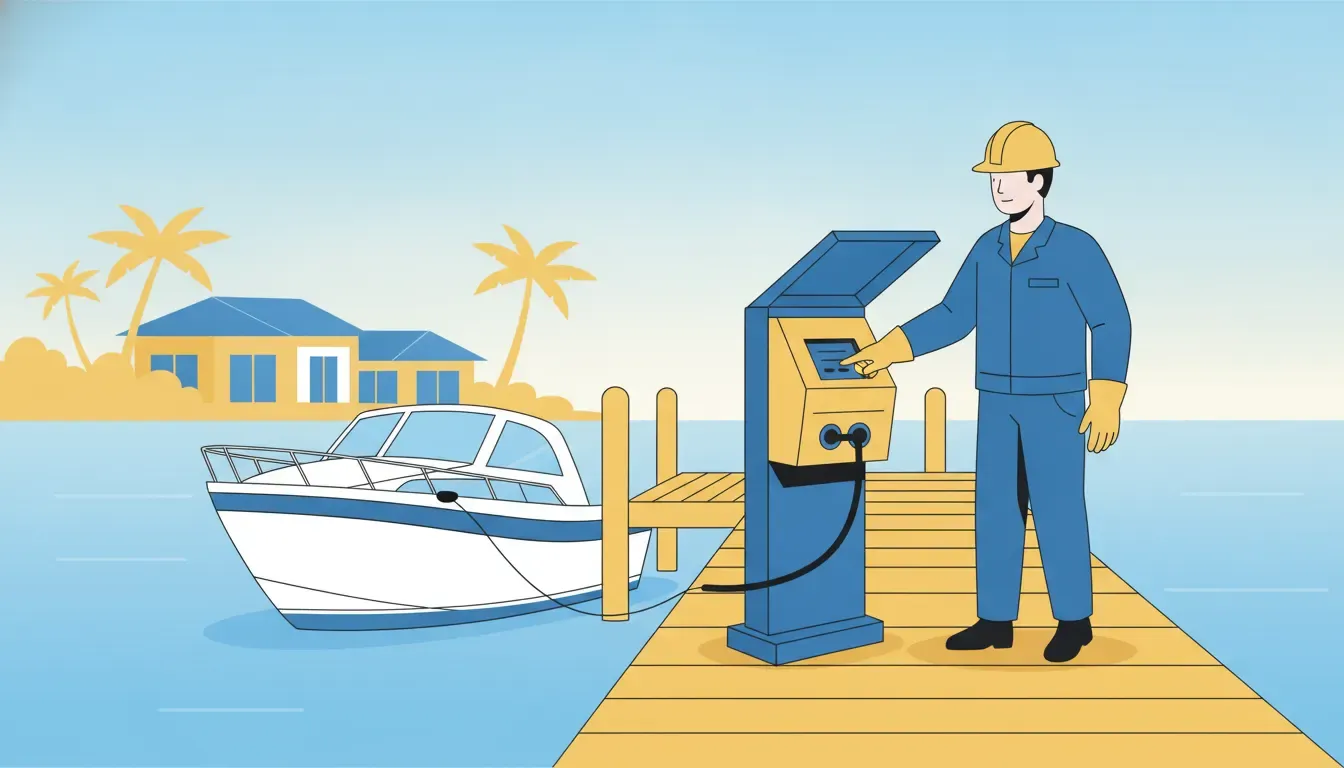
Dock shore power installation safety deserves more attention than simply adding an outlet near the water. A shore power system connects a boat to a building or marina electrical supply, so a mistake in grounding, bonding, protection, equipment selection, or weatherproofing can put people, boats, and the dock at risk. In Florida, rain, salt air, storms, flooding, and corrosion make the evaluation even more important.
Schedule an electrical evaluation for your dock shore power system in Florida.
This guide explains what homeowners, waterfront property owners, dock managers, and marina operators should ask before installing or modifying shore power. It is educational, not a substitute for a site-specific design, permit review, inspection, or repair by a qualified electrical contractor.
What Is Dock Shore Power?
Dock shore power is the electrical connection that lets a boat receive power from a dockside pedestal or receptacle instead of relying only on onboard batteries or a generator. A safe system coordinates the shore supply, feeder, protection, dockside equipment, cord and inlet, boat-side distribution, grounding, and bonding. The system must be evaluated as a complete connection, not as an isolated receptacle.
Shore power is different from dock lighting. Dock lighting illuminates a walkway or boat lift area. Shore power supplies a vessel and may support battery chargers, refrigeration, air conditioning, water heaters, tools, or other loads. That connection can expose electrical faults to a wet environment, a metal boat, a dock structure, and people in or near the water.
The U.S. Coast Guard Boating Safety Circular 81 discusses shore power cable configurations, receptacles, connectors, locking features, grounding, and wiring identification. The specific equipment for a property must still be selected for the actual voltage, amperage, boat connection, dock conditions, and applicable requirements.
Why Is Shore Power Near Water a Serious Safety Issue?
Shore power near water is serious because water, people, metal components, and electrical equipment can create a path for current when a fault occurs. Grounding and bonding help direct fault current through a controlled path so protective devices can respond. Ground-fault protection can disconnect power when leakage is detected. These safeguards must be designed, installed, tested, and maintained together.
The National Fire Protection Association explains electric shock drowning risks and recommends proper ground-fault protection for circuits supplying boats. NFPA also discusses marina electrical safety, including the importance of bonding, grounding, inspection, and maintenance in its guide to navigating electrical safety through marina waters.
Florida conditions can increase the chance that a system will deteriorate between inspections. Salt air can accelerate corrosion. Heavy rain can expose weak seals and damaged covers. Storms can move docks, damage conduits, or leave equipment wet and contaminated. A system that worked when installed may need another evaluation after a storm, remodel, equipment change, or repeated nuisance trip.
What Should a Florida Shore Power Installation Evaluation Include?
A Florida shore power evaluation should review the existing electrical service, the dock and boat connection, water exposure, protection, grounding and bonding, equipment condition, load demands, and local approval requirements. The goal is to identify the safe installation approach before anyone selects a pedestal, runs a cable, or energizes a receptacle.
- Site and dock conditions: Identify whether the dock is fixed, floating, residential, commercial, or part of a marina. Review movement, water level changes, access, flood exposure, nearby metal parts, and the location of the boat connection.
- Electrical capacity: Review the service, panel, feeder, available capacity, voltage, and expected simultaneous loads. A new dock connection should not be treated as a small add-on without checking the source.
- Protection and disconnecting: Confirm that protective devices and disconnects are appropriate for the equipment and installation. The final approach depends on the design, equipment listing, adopted code, and authority having jurisdiction.
- Grounding and bonding: Review the equipment grounding path and bonding of applicable metal parts. The Florida Building Commission has published an analysis discussing Article 555 questions involving metal parts in contact with water and parts likely to become energized. That is a strong reminder that bonding questions require a site-specific review.
- Wet-location equipment: Check enclosures, covers, fittings, receptacles, pedestals, conduit, cable routing, strain relief, and corrosion resistance. Equipment should be suitable for its exposure and installed so water cannot defeat the protection.
- Testing and documentation: Plan for testing, labeling, inspection, and clear instructions for users. A system is not complete when the cable is connected. It is complete when the installation has been tested and the owner understands how to use and maintain it.
For Florida code context, the Florida Building Commission staff analysis of a dock bonding question shows why a seemingly simple residential dock project can involve Article 555, bonding, and electrical shock considerations. It does not replace the requirements for the specific project or the decision of the local authority having jurisdiction.
Which Shore Power Components Need Careful Planning?
Every part of the connection matters because a failure at one point can affect the entire system. A qualified evaluation should consider the following components as a coordinated design:
| Component | Safety questions to ask |
|---|---|
| Power source and panel | Is there enough capacity, and is the feeder protected and routed for the environment? |
| Pedestal or receptacle | Is the equipment listed for the location, protected from weather, accessible, and compatible with the boat connection? |
| Grounding and bonding | Are required metal parts and equipment connected through the intended fault-current path? |
| Ground-fault protection | Is the protective equipment appropriate for the dock, feeder, receptacle, and boat-side arrangement, and has it been tested? |
| Shore power cord | Is the cord the correct type and rating, free from cuts or heat damage, and routed so it is not crushed or submerged? |
| Boat inlet and panel | Are the inlet, main disconnect, wiring, and boat equipment in good condition and compatible with the dock supply? |
| Weather and corrosion control | Can rain, spray, salt, flooding, movement, or ultraviolet exposure compromise the installation? |
Do not assume that a familiar household extension cord, indoor receptacle, power strip, or adapter is suitable for shore power. The Electrical Safety Foundation International boat operator guidance recommends using marine power cords, plugs, receptacles, and extension cords that are tested and appropriate for the application. A qualified electrician can evaluate the fixed installation, while a marine professional may need to evaluate boat-side equipment.
How Does Florida Weather Change Shore Power Safety?
Florida weather changes shore power safety by adding moisture, salt, heat, wind, flooding, and storm exposure to an already demanding electrical environment. Coastal conditions can shorten the useful life of metal parts and seals. A design that works on a dry day may be unsafe if water enters a damaged enclosure or a storm shifts a floating dock and strains the wiring.
Use a seasonal and post-storm inspection mindset. Before reconnecting power after severe weather, look for water intrusion, displaced equipment, cracked covers, exposed conductors, damaged conduit, corrosion, loose supports, and cords lying in standing water. Do not energize equipment that has been submerged or visibly damaged until a qualified professional evaluates it.
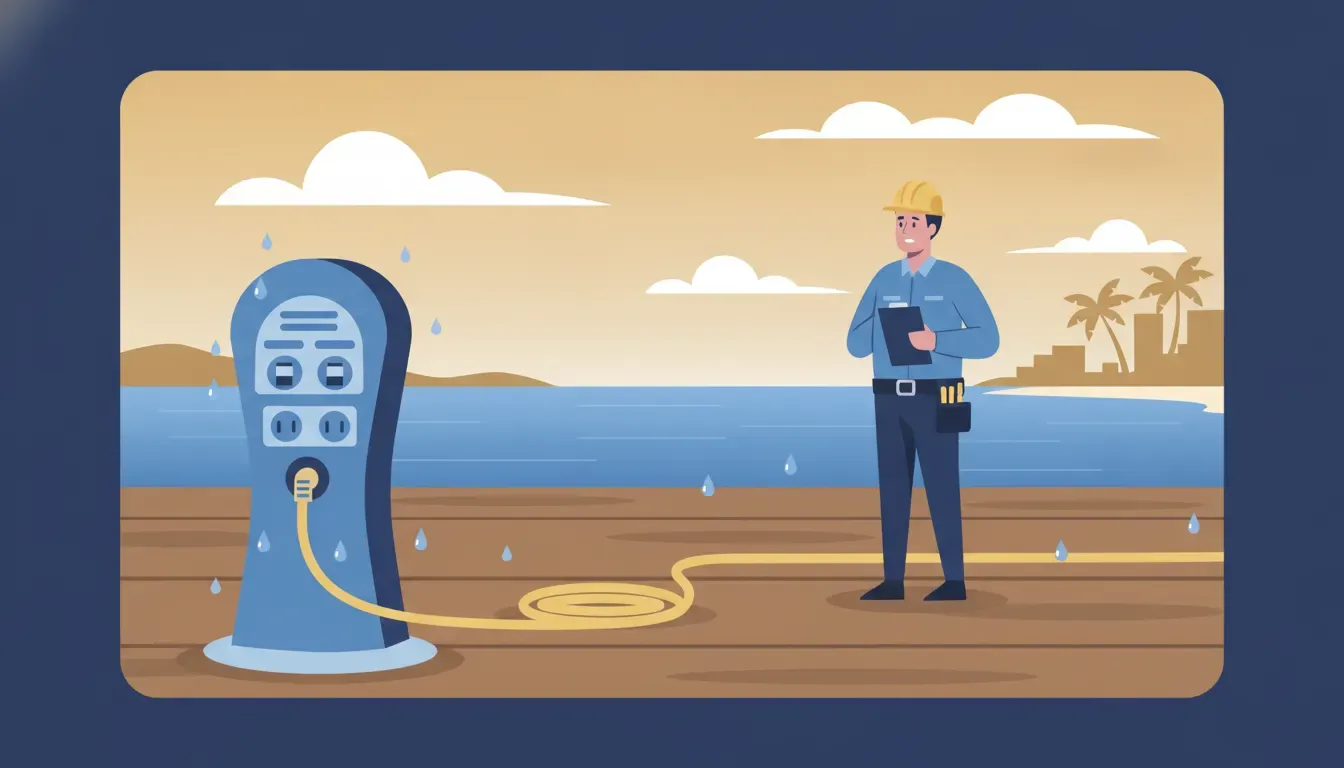
Waterfront electrical equipment needs inspection after severe weather or visible damage.
- Keep receptacles, cords, and connections out of standing water.
- Do not defeat a protective device because it trips repeatedly.
- Keep swimmers away from a dock when shore power is connected or when an electrical fault is suspected.
- Do not handle a damaged cord, plug, or receptacle with wet hands.
- Arrange an inspection after a lightning event, storm surge, flooding, dock movement, or major equipment change.
If someone feels a shock or tingling sensation near a dock, do not enter the water to help and do not touch the person directly if the electrical source may still be energized. Call emergency services, keep people away from the area, and have the electrical system evaluated. The danger may not be visible from the dock.
What Warning Signs Mean a Dock Power System Needs Service?
Warning signs can appear at the pedestal, shore power cord, boat inlet, panel, dock structure, or water around the dock. A single symptom is enough to stop using the affected connection until it can be evaluated. Repeated resets are not a repair strategy because they can hide a fault or deteriorating component.
- Burning smell, smoke, discoloration, melted plastic, or heat at a plug or receptacle.
- Buzzing, crackling, visible arcing, flickering, or unexplained loss of power.
- Repeated tripping of a breaker or ground-fault protective device.
- Rust, white or green corrosion, cracked covers, missing hardware, or water inside an enclosure.
- Frayed, crushed, stiff, cut, or unusually warm shore power cords.
- A shock, tingle, or unusual sensation on a boat, ladder, rail, dock hardware, or in the water.
- Damage after a hurricane, tropical storm, flooding, lightning, impact, or dock movement.
For urgent electrical danger, use My Electrician's emergency electrical service and keep everyone away from the suspected hazard. For non-urgent concerns, an electrical repair evaluation can help identify whether the problem is at the building supply, dock equipment, cord, or boat connection.
Should a Homeowner Install Shore Power Without an Electrician?
Homeowners should not self-install or modify dock shore power. The work can involve service capacity, wet-location wiring, grounding, bonding, protection, structural movement, permits, inspections, and coordination with a marina, dock contractor, boat electrician, or local authority. The risk is not limited to getting the receptacle wired correctly. It includes how the complete system behaves when equipment fails near water.
A homeowner can prepare useful information for the evaluation:
- Take photos from a safe, dry location without opening energized equipment.
- Record the dock type, approximate distance to the electrical panel, and whether the dock moves with water levels.
- List the boat equipment and expected shore loads, such as chargers, air conditioning, refrigeration, or tools.
- Note any trips, heat, corrosion, shocks, storm damage, or prior repairs.
- Ask which work requires a permit, who will coordinate inspection, and which tasks belong to a marine professional.
When comparing contractors, verify the business and license information through the Florida Department of Business and Professional Regulation license search. Ask for a written scope that separates the electrical evaluation, installation, testing, repairs, and any work that must be completed by another qualified trade.
How Is Shore Power Different From Dock Lighting?
Dock lighting and shore power may share a waterfront setting, but they are different electrical scopes. Lighting focuses on fixtures, controls, visibility, and the lighting circuit. Shore power creates a vessel-to-building electrical connection with additional considerations for boat inlets, cord sets, load demands, grounding, bonding, and protection.
| Project | Primary purpose | Why the evaluation differs |
|---|---|---|
| Dock lighting | Illuminate the dock, steps, boat lift, or surrounding area | Focuses on fixture location, controls, wet-location ratings, visibility, and the lighting circuit |
| Shore power | Supply electrical power to a boat at the dock | Adds boat connection, load, bonding, grounding, cord, protective-device, and user-safety questions |
| Combined project | Power both lighting and a boat connection | Requires coordinated load, routing, protection, separation, and inspection planning |
My Electrician's dock lighting safety guide covers the lighting side of a waterfront project. Do not treat completion of a lighting upgrade as approval for adding shore power. The two scopes should be evaluated separately and then coordinated where they share a panel, feeder, dock structure, or bonding system.
What Questions Should You Ask Before Shore Power Work Begins?
Before work begins, ask questions that clarify safety, scope, responsibility, and verification. A clear written answer is more valuable than a quick promise that a receptacle can be added.
- What loads will the boat and dock equipment place on the existing service?
- Which shore power voltage, amperage, receptacle, cord, and inlet are appropriate?
- How will grounding, bonding, and ground-fault protection be designed and tested?
- How will salt air, rain, flooding, UV exposure, dock movement, and storms affect the installation?
- What permits, inspections, marina approvals, or homeowner association approvals apply?
- Which work belongs to the electrical contractor, dock contractor, boat electrician, or marina operator?
- How will the system be labeled, tested, documented, and maintained after installation?
- What conditions would require stopping work or replacing existing equipment instead of reusing it?
NFPA 303 is an active standard for protecting people and property from fire and electrical hazards at marinas, boatyards, yacht clubs, boat condominiums, and docking facilities. It is a useful reference point for understanding why waterfront electrical work needs a deliberate safety process, but the applicable code edition and local enforcement requirements must be confirmed for the project.
Frequently Asked Questions
Is shore power safe on a residential dock?
Shore power can be safe when it is properly designed, installed, protected, bonded, grounded, inspected, and maintained for the specific dock and boat connection. It is not safe to assume that any outdoor receptacle is suitable. Water exposure, corrosion, dock movement, and boat-side equipment all need to be considered.
Can I plug a boat into a regular outdoor outlet?
Do not use a regular outdoor outlet as a substitute for a purpose-designed shore power system. The correct connection depends on the boat inlet, cord, voltage, amperage, protective devices, equipment listing, grounding, bonding, and local requirements. Have a qualified professional evaluate the system before use.
What should I do if a dock breaker keeps tripping?
Stop resetting the breaker and disconnect people from the area. A repeated trip can indicate a fault in the boat, cord, inlet, pedestal, feeder, or another connected load. Keep the dock and water area clear, then arrange an evaluation to identify the cause before restoring power.
Should shore power be disconnected before a storm?
Follow the boat, marina, and electrical equipment instructions for storm preparation, and disconnect power only from a safe, dry location using the intended disconnect. Never handle a wet or damaged cord. After a storm, have flooded, shifted, corroded, or damaged equipment evaluated before reconnecting it.
Does dock lighting use the same safety rules as shore power?
Dock lighting and shore power both require equipment suitable for the environment, but they are not the same scope. Shore power adds a boat-to-building connection, larger or different loads, cord and inlet concerns, and additional grounding, bonding, and protective-device questions. A lighting project does not automatically approve shore power.