
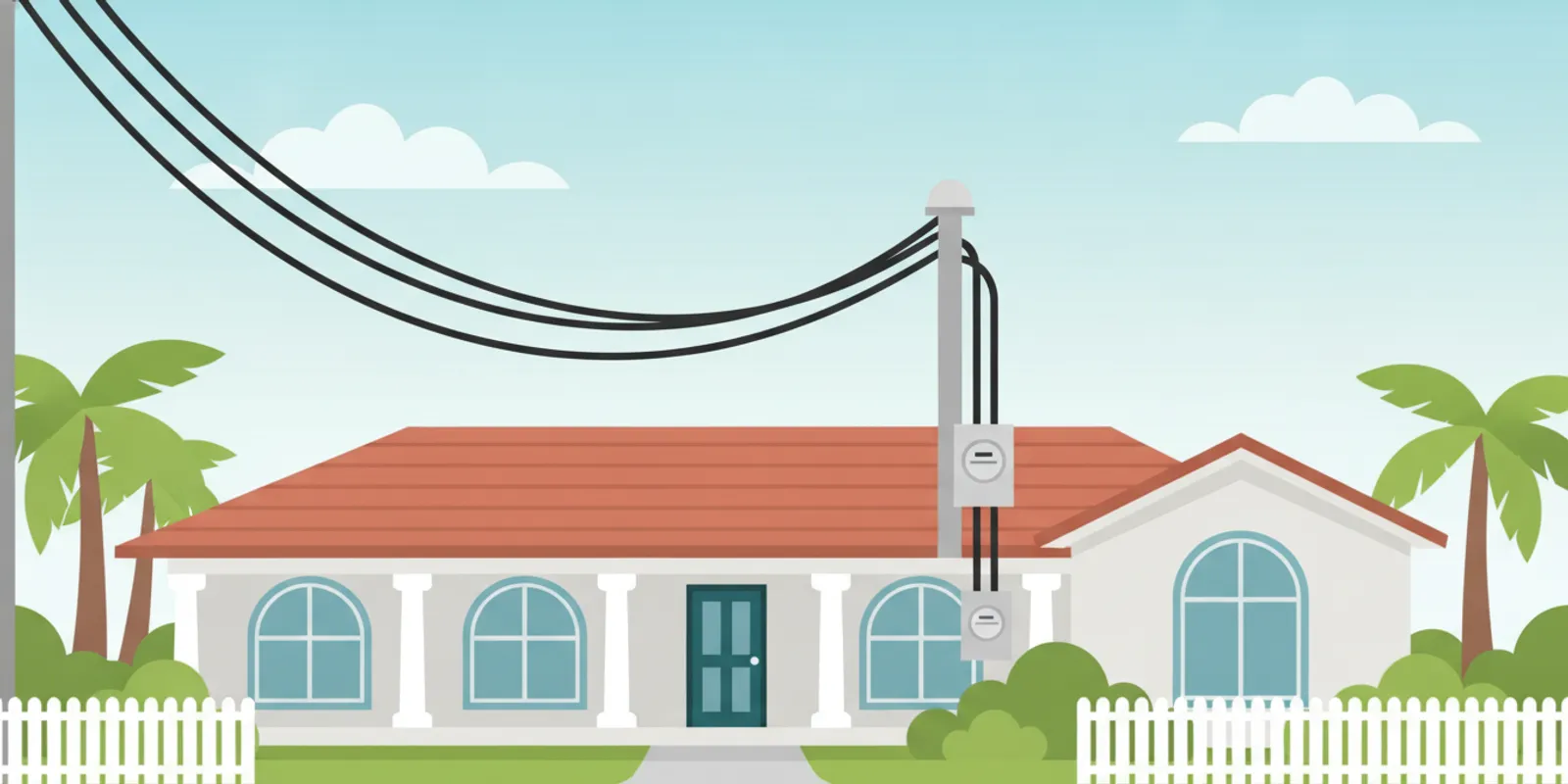
Electrical service mast requirements matter when an overhead connection is damaged, a roof is being changed, or a home renovation brings work close to the service entrance. The mast supports overhead conductors where they connect to the building, but the correct arrangement depends on the home, the utility, and the applicable rules. Florida homeowners should treat the assembly as electrical equipment, not a do-it-yourself repair.
Request an electrical assessment
What is an electrical service mast?
An electrical service mast is a conduit or approved assembly that extends above a building and supports overhead service conductors. The conductors carry power from the utility connection toward the meter and service equipment. A mast is often visible near a roof edge, but homes do not all use the same service arrangement. Some properties have different equipment or an underground service instead.
People may use “service mast” to mean the entire overhead service entrance. The assembly can involve a conduit, weatherhead, conductors, attachment hardware, meter equipment, and the connection to the home's electrical system. These components have related but distinct jobs. The weatherhead helps direct water away from the conduit opening. The mast and its attachment support the service conductors, which can place mechanical force on the structure.
The National Fire Protection Association provides general information about electrical and fire safety and the codes it develops at NFPA. That general information is not an inspection, a local permit decision, or a determination that a particular mast complies. For a property-specific answer, an electrician and, when necessary, the serving utility or local permitting authority need to assess the actual installation.
Which requirements apply to a service mast?
There is no single height, conduit size, or mounting detail that can be applied to every house from a general online description. Requirements can depend on the electrical code adopted for the location, local permitting and inspection rules, the serving utility's service standards, the type and condition of the building, and the equipment selected. The route of the conductors and the spaces around them also matter.
That is why a measurement from a different home, a diagram found online, or an estimate based on a photograph should not be used as an installation plan. Even where two houses look similar from the street, they may have different rooflines, attachment points, service equipment, or utility arrangements. A qualified professional can identify what applies and whether a utility representative must review the proposed work.
| Area to assess | Why it matters | Useful homeowner action |
|---|---|---|
| Mast, conduit, and supports | The assembly must be suitable for the installation and remain securely attached. | Look from a safe place for obvious leaning, separation, impact, or corrosion; do not touch it. |
| Weatherhead and conductors | These parts form the overhead route into the service equipment and are exposed to weather. | Report visible damage, displaced parts, or conductors that appear exposed. |
| Clearance and location | Required space depends on the conductor arrangement and what is below or beside it. | Keep people, ladders, tools, and project materials away from the overhead line. |
| Meter and service equipment | Changes at the mast may affect connected equipment and the service arrangement. | Ask the electrician to explain which equipment is included in the proposed scope. |
| Utility coordination | The utility and property owner may have different responsibilities for service components. | Confirm who contacts the utility and who authorizes any disconnection or reconnection. |
| Permits and inspection | Local rules may require approvals or inspection for alteration or replacement work. | Before work begins, ask who will confirm permit and inspection requirements. |
What affects overhead clearance?
Overhead conductors need appropriate space from roofs, windows, decks, balconies, driveways, trees, and areas where people or vehicles may pass. The distance is not a universal number for every location. It can depend on the type of space, conductor and service arrangement, and rules that apply to the property. A safe conclusion requires identifying the actual setup and the applicable standards.
Changes to the building can alter the space around a service. A new roof, raised addition, porch, deck, pool enclosure, or other structure may bring a surface closer to the conductors or change access to the attachment. Tree growth can also create a conflict that was not present when the service was installed. Before a contractor begins work that may affect the roofline or vegetation, ask for the electrical service to be considered in the project plan.
Do not use a ladder, tape measure, pole, or camera on an extension to estimate a clearance. Do not reposition a line to make room for construction. A homeowner can take a photograph from a safe, ground-level location if there is no immediate danger, but a photo is only useful background for a professional. It does not replace inspection or measurement by someone qualified to assess the equipment.
What should you look for from the ground?
A visual check from a safe distance may help you notice a change. It cannot prove that the mast meets code or determine whether conductors are safe. Look for apparent issues such as:
- A mast that seems bent, loose, pulled away from the wall, or visibly out of position.
- Cracked, displaced, or damaged conduit, a broken weatherhead, or conductors that appear exposed.
- Signs of impact from a branch, roof work, a vehicle, or construction equipment.
- Scorching, smoke, arcing, unusual buzzing, or a burning odor at or near service equipment.
- Water intrusion or damage around the service entrance, meter, or nearby wall.
- New construction, a roof change, or tree growth that appears to encroach on the overhead line.
Do not climb onto the roof, touch the mast, move a branch that is contacting equipment, or try to tighten a bracket. Turning off the main breaker does not make the utility conductors safe to handle. If a line is down, sparking, smoking, or creating immediate danger, keep people well away and contact emergency services and the utility. For a concern without immediate danger, arrange an evaluation by a qualified electrician. For urgent electrical problems, review the company's emergency electrical service information.
Who is responsible for the mast and service connection?
Responsibility can be divided between the property owner and the electric utility. The dividing point depends on the equipment and the utility's arrangement for that address. Do not assume every component mounted outside belongs to the utility, or that the homeowner can authorize work on every part. Ask the utility and electrician to clarify responsibility before repair or replacement is scheduled.
An electrician can assess accessible customer-side equipment, explain apparent concerns, and advise whether utility coordination is needed. The utility may need to be involved when work affects its conductors or the connection. The electrician can also explain what needs to happen before work starts, including whether service interruption, a permit, an inspection, or a utility appointment may be part of the plan. For a broad view of electrical work available from My Electrician, see the electrical services page.
Responsibility questions are easier to resolve when you can identify the exact issue and location. If damage is visible, describe what you see without approaching it. If the concern is a planned project, share drawings or a description of the roof, addition, or tree work. The professionals involved can then identify whether the project affects the service entrance and who should be contacted next.
How should you plan roof, tree, or exterior work?
Include the overhead service in planning before the contractor starts, not after a ladder or equipment is already in place. This is especially important when work changes a roof edge or brings workers, long materials, or machinery near conductors. The following sequence helps keep the right questions visible:
- Describe the planned work. Note which roof section, wall, tree, or exterior structure will be changed and when the project is expected to start.
- Identify possible conflicts. From a safe location, note whether the work area appears near the mast, the service drop, or the route used by the conductors. Do not measure or handle the line.
- Ask for an electrical review. Contact an electrician before the contractor begins work if the scope could affect service equipment or access to it.
- Confirm who coordinates with the utility. Establish whether the electrician, property owner, or project contractor will contact the utility and what approvals are needed.
- Agree on the safe work sequence. Ask what must be completed before roof, tree, or construction work begins and who will confirm the service is ready afterward.
For instance, a homeowner arranging roof replacement may notice that the mast passes through or sits beside the roof area. The practical next step is not to ask roofers to shift it temporarily. Instead, explain the roof scope to an electrician and ask whether the existing service arrangement needs attention and whether utility coordination is necessary. A tree contractor facing a branch close to overhead conductors should also pause and obtain direction rather than attempting to work around energized equipment.
For related electrical planning, My Electrician describes its electrical inspection services and electrical repair services. Those pages provide service context; an electrician still needs to determine the appropriate scope for the specific property.
What happens during a professional evaluation?
A useful evaluation starts with the reason for the call and the property's service arrangement. The electrician may ask when the problem began, whether there was storm or tree damage, whether a vehicle or tool struck the equipment, and whether roof or exterior work is planned. The answers help identify whether the concern is damage, a clearance question, an aging installation, or coordination for a renovation.
The professional can then assess accessible parts of the equipment and determine what questions need further review. Depending on the situation, next steps may include repair or replacement planning, coordination with the utility, permit confirmation, and inspection. The exact work cannot be determined from a general checklist. It depends on the conditions found and the requirements that apply to the address.
- Share the history. Explain what changed, when it happened, and whether you noticed a new sound, odor, outage, or other symptom.
- Provide safe documentation. If there is no immediate hazard, share ground-level photographs and the project details. Do not approach damaged equipment to get a closer image.
- Ask what will be assessed. Confirm whether the discussion covers the mast, attachment, conductors, meter area, and related service components.
- Clarify responsibility and coordination. Ask whether the utility or local permitting authority needs to be involved, and who will handle those contacts.
- Review the proposed sequence. Before work is authorized, understand any planned service interruption, approvals, inspection, and reconnection steps that apply.
- Keep the area clear until the plan is set. Do not begin roof, tree, or construction work that could conflict with the service while the issue remains unresolved.
Before arranging work, you can check the company's service area information and learn more about My Electrician. The purpose of these steps is to make the evaluation and coordination clear, not to diagnose a mast from a distance.
Why is DIY mast work unsafe?
A service mast is connected to the overhead electrical system. Work on it may expose a person to energized conductors, a fall from a roof or ladder, and damage to equipment or the building. The main breaker does not de-energize every part of an overhead service. A person may also unintentionally alter a connection or support in a way that creates a new hazard.
Do not install, reposition, repair, or attach anything to the mast yourself. Do not route cables alongside the conductors or ask an unqualified contractor to move them. Avoid trimming vegetation that is touching electrical equipment. If a project involves the service entrance, discuss the plans with an electrician and the utility as needed before work starts. For additional general guidance about choosing professional help, read when to call an electrician.
How can you compare possible next steps?
The appropriate response depends on whether there is immediate danger, visible damage, or a planned project. This comparison can help you choose who to contact first without attempting to diagnose the installation yourself.
| Situation | First action | What to avoid |
|---|---|---|
| Downed, sparking, smoking, or otherwise immediately dangerous line | Keep everyone well away and contact emergency services and the utility. | Do not approach, touch, move objects near it, or attempt a repair. |
| Visible damage without immediate danger | Keep clear and arrange an electrician's assessment; ask whether utility coordination is needed. | Do not climb, handle equipment, or assume the main breaker makes it safe. |
| Roof, tree, or exterior project near the service | Discuss the scope with an electrician before work begins and confirm coordination needs. | Do not let a crew shift or work around conductors without an approved plan. |
| Question about compliance or an older installation | Request a professional assessment and ask which local and utility requirements apply. | Do not treat a neighbor's setup, online measurement, or photograph as a standard. |
If the concern involves a broader electrical issue at the property, the company's electrical panel service information may help you identify the right topic to discuss. It does not establish that a panel or mast needs replacement; that determination belongs to an in-person assessment.
What information should you gather before requesting work?
You do not need to identify the failed part before calling. A clear description of the symptoms and project context is more useful than a guess about a specific code or component. If it is safe to do so, note when the condition first appeared, whether it followed a storm or impact, and whether anything else changed around the home at the same time. Share only observations made from a safe distance.
For planned work, describe the scope in practical terms. Mention whether a roofer will remove or change material around the mast, whether an addition will alter the roofline, or whether tree work may take place near overhead conductors. Provide the expected project timing so the electrician can tell you what should be reviewed before a crew arrives. If drawings or contractor notes already exist, ask whether they would help clarify the proposed work.
Before approving a proposed scope, ask direct questions that make responsibilities and sequence clear:
- Which parts of the service entrance are being evaluated, and what condition was observed?
- Is the recommendation based on visible damage, the planned construction, a permit requirement, or another finding?
- Does the utility need to review, disconnect, reconnect, or otherwise coordinate any part of the work?
- Who will confirm any permit and inspection steps with the appropriate local authority?
- Will the home have a planned service interruption, and what needs to happen before power is restored?
- What should the homeowner and other contractors keep clear before and during the work?
These questions help distinguish a necessary repair from work that may involve coordination or a broader project plan. They also reduce the risk of one contractor assuming another person has already contacted the utility. The electrician should be able to explain the proposed work in terms you can understand and identify any unresolved coordination before work proceeds. If you are comparing recommendations, compare the scope and stated reason, not just a label such as “mast replacement.”
How do these steps work in common situations?
After a branch strikes the service: If the branch has pulled equipment out of position, brought down a wire, or produced sparks or smoke, treat the area as dangerous. Keep everyone away and contact emergency services and the utility for immediate hazards. Do not move the branch, inspect the attachment at close range, or assume that an outage means the conductors are safe. Once the immediate hazard is addressed, an electrician can assess damage to the building-side equipment and explain what coordination remains.
Before replacing a roof: A homeowner may see the mast near the edge of the roof but not know if the roof crew can safely proceed. Share the project details with an electrician before the crew begins. The professional can assess whether the service arrangement or access is affected and whether the utility or local authority must be involved. The roof contractor should not make an informal adjustment to the mast or conductors to speed the job.
When a service looks old but has no obvious damage: Age alone, as seen from the street, does not tell a homeowner whether equipment must be replaced. Do not try to test the mast by pushing it or climbing up for a closer look. Ask for an evaluation and explain why you are concerned. The assessment can separate an observable defect from a general question about condition, clearances, or a future renovation.
When a new deck or enclosure is planned: Include the service entrance in early design conversations. A structure can change access and spacing even if it does not touch the mast. Before construction, ask an electrician to review the proposed layout and identify whether any part of the service or conductor route needs attention. Resolving questions during planning is more manageable than discovering a conflict after materials arrive.
In each case, the homeowner's role is to notice, describe, and keep people clear—not to determine the installation measurements or alter electrical equipment. A professional assessment provides the basis for decisions and helps identify which parties need to take part.
Frequently asked questions
Does every home with overhead power have a service mast?
No. Service methods and equipment vary by property. Some homes have a different overhead arrangement, and others receive service underground. An electrician can identify the equipment at your address.
Can I tell from the ground whether my mast meets requirements?
No. A ground-level view may reveal obvious damage or a possible conflict, but compliance depends on the actual installation, measurements, applicable code and local rules, and utility standards. A qualified professional must evaluate the situation.
Should I call the utility or an electrician first?
If a line is down, sparking, or creating immediate danger, stay away and contact emergency services and the utility. For non-emergency damage or planned work, contact an electrician to assess the equipment and help determine whether utility coordination is needed.
Can a roofer or tree contractor move the conductors?
Do not ask a contractor to handle or move energized conductors. Plan the work with an electrician and the utility as needed before the project begins.
Will turning off the main breaker make mast work safe?
No. The overhead service conductors can remain energized even when the main breaker is off. Do not touch or work on the mast; arrange professional help.
Discuss your service mast with an electrician
If overhead service equipment appears damaged or a project may affect it, keep people clear and arrange a professional assessment before work proceeds.