
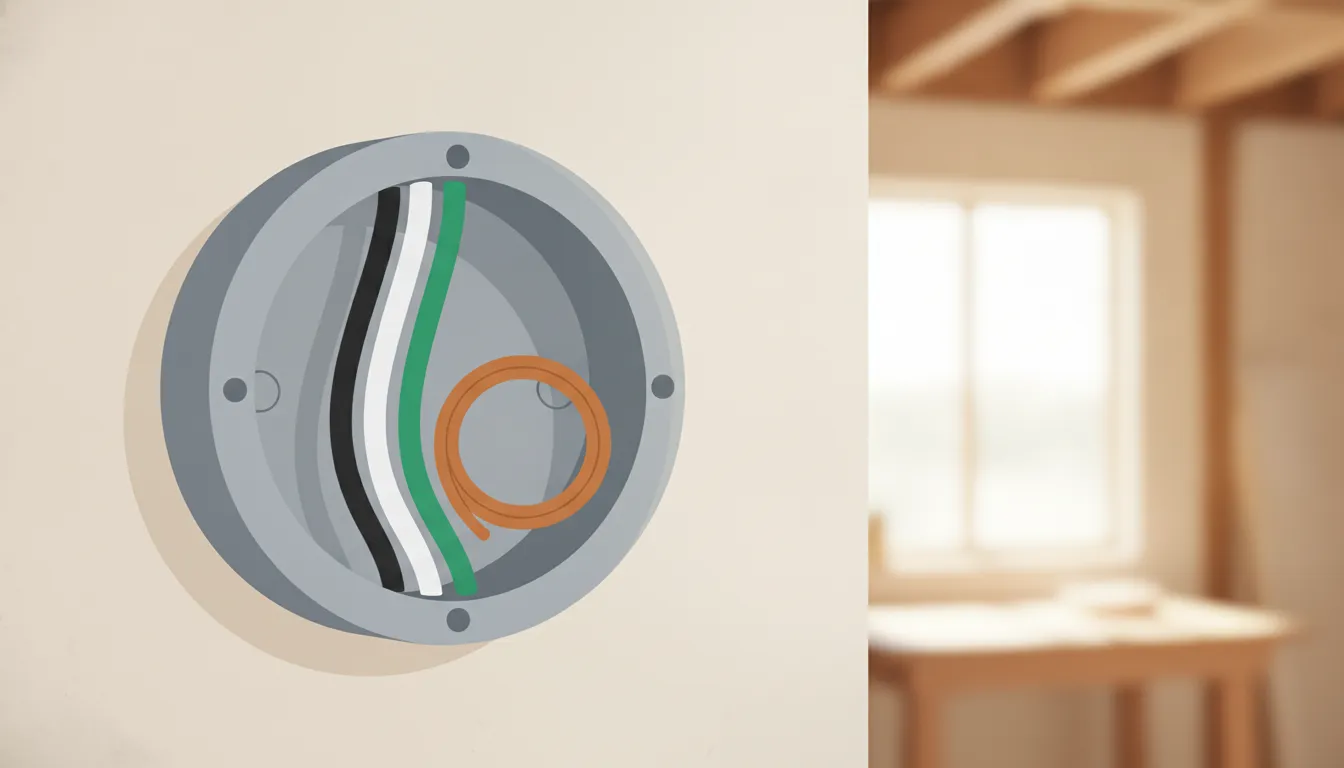
Open a switch or outlet box in a Port St. Lucie home and the electrical wire colors are the first thing you see. Black, white, bare copper, and sometimes red or green each have a usual job on a modern U.S. branch circuit. Color is a label, not a guarantee. Older Treasure Coast houses, added circuits, and marked conductors can break the pattern you expect.
Book a wiring check with My Electrician
My Electrician, Inc. has served homes and businesses from Vero Beach to West Palm Beach since 2000. Licensed electricians (EC13003398) quote the work in full before it starts and back parts and labor with a written two-year guarantee. If a box does not match the colors below, stop and call. Do not treat a color chart as permission to reconnect anything.
What electrical wire colors usually mean
On a typical 120-volt branch circuit in a U.S. home, insulation color is how electricians tell conductors apart before they test. The National Electrical Code sets identification rules that Florida inspectors use. Our guide to what NEC electrical code means for Florida homeowners covers how the state adopts that code. This page stays on color only. For the broader work behind a repair, start with our electrical services.
The identification rules are specific. An insulated grounded (neutral) conductor is white or gray. An insulated equipment grounding conductor is green, or green with a yellow stripe. A hot, or ungrounded, conductor may be any color except white, gray, green, or green with a yellow stripe. NEC 250.119 also allows an equipment grounding conductor to be bare. In a house, that bare wire is usually copper.
Those rules describe identification. They do not promise that the last person in the box followed them. A white wire with black tape can be a hot. A green wire should never be used as a hot, but a past mistake can still put voltage on a color you trust. Look, then have the circuit tested with the power off at the breaker and verified dead before anyone touches a conductor.
Black, red, and other hot electrical wire colors
Black is the usual hot on a 120-volt circuit. It carries current from the breaker to the switch, light, or receptacle. In a cable, black is the conductor people notice first. It is also the one most likely to be energized when the breaker is on.
Red is a second hot. You will see it on many 240-volt circuits, such as a range, dryer, or water heater. Black and red each connect to a different breaker pole. Red also shows up as a switch leg, the conductor that runs from a switch up to a light.
Orange sometimes marks a high-leg or another distinct hot in multiwire or commercial work. Blue and yellow are less common in older houses. They show up more often as travelers or extra hots in conduit.
A hot is not safe because it is black, and it is not safe to grab because it looks switched off. Breakers get mislabeled. A switch can interrupt the neutral instead of the hot if someone wired it backward years ago. If you need a new circuit for a workshop, office, or appliance, that is dedicated circuit work, not a color-matching project.
Travelers are the pair of hots that run between three-way switches. They are often black and red, but they can be any hot color. Older cable sometimes uses a re-marked white as one traveler. The color does not tell you which switch position is which.
A hallway that works from two locations needs a different plan than a single switch. We cover switch replacement decisions, without a wiring tutorial, on the switches and outlets service page.
White, gray, green, and bare copper
White, and sometimes gray, is the neutral. It completes the circuit back to the panel. A neutral can still shock you. It carries return current whenever a load is on, and an open neutral can leave metal parts and other conductors at a dangerous voltage. Never use a neutral as a ground, and never assume a white wire is dead because the light is off.
Green, green with a yellow stripe, or bare copper is the equipment ground. It is a safety path, not a normal current-carrying conductor. Under NEC 250.119, an insulated equipment grounding conductor keeps that green finish for its entire length.
Bare copper in plastic-sheathed cable does the same job without insulation. The ground should bond the metal box, the device yoke when required, and the panel. It should not land on a hot or neutral terminal.
Two mistakes show up often when a homeowner opens a box:
- A white conductor taped black or red at both ends is being used as a hot. The tape is the real label. The white insulation underneath is not.
- A ground wire landed under a neutral screw, or a neutral used in place of a missing ground, hides a fault instead of clearing it. That is a repair, not a shortcut.
If the ground is missing, the cable is cloth-covered, or the conductors look dull and oxidized, a new-cable color chart will not describe the wall. Older systems are a different conversation.
Read the signs on our faulty wiring repair page before you plan any update. Separate notes cover aluminum wiring in Florida homes and knob-and-tube wiring.
Electrical wire colors at a glance
Use this as a field card for modern U.S. residential cable, not as a wiring diagram. Confirm every conductor before any work. Local amendments and the age of the house can change what you find.
| Color or finish | Usual role | Where you often see it | Do not assume |
|---|---|---|---|
| Black. | Hot, or ungrounded, conductor. | Common on 120-volt branch circuits. | Do not assume the breaker label matches this wire. |
| Red. | Second hot conductor. | Common on 240-volt pairs and switch legs. | Do not assume red is always the switch leg. |
| Blue or yellow. | Extra hot or traveler. | Common in conduit and three-way switches. | Do not assume the pair is interchangeable by eye. |
| White or gray. | Neutral, or grounded, conductor. | Common as the return on 120-volt circuits. | Do not assume white is safe to touch or still a neutral. |
| White with black or red tape. | Re-identified hot conductor. | Common in switch loops and some 240-volt cables. | Do not assume the tape is still there at the other end. |
| Green, or green with a yellow stripe. | Equipment grounding conductor. | Used on insulated grounding conductors. | Do not assume green was never misused in an old repair. |
| Bare copper. | Equipment grounding conductor. | Common inside NM cable. | Do not assume a bare wire is abandoned scrap. |
Commercial panels and buildings with more than one voltage often add another identification step. NEC 210.5(C) and 215.12(C) require phase conductors to be identified by system when more than one nominal voltage is present. A shop or restaurant in Stuart or Fort Pierce may use tape or labels that a house does not. If you manage a business panel, ask for that legend instead of copying a residential chart.
When the color in the box is wrong
Color fails in predictable ways. Knowing the pattern keeps you from "fixing" a safe quirk or ignoring a real one.
- Switch loops in older cable use the white wire as a hot, with black or red tape at the ends. If the tape has fallen off, the white looks like a neutral and is not one.
- A 240-volt cable may contain black, white, and ground, with the white re-marked as the second hot. Both insulated conductors are hots. There may be no neutral in that cable at all.
- Previous repairs sometimes join a new copper pigtail to old aluminum, or extend a cloth-insulated conductor with modern colors. The new jacket only describes the new piece.
- A bootleg ground ties the neutral and ground together at a receptacle. The outlet tester may look normal while the metal box is waiting on a neutral fault.
- Travelers between three-way switches can be any hot color. Matching black to black because the last box looked that way is how a hallway light ends up stuck on.
None of these are DIY corrections. Turn the breaker off if you can do it without touching a damaged device, keep people away from a warm or buzzing box, and let a licensed electrician identify each conductor. For homes that need more than one device replaced, start with house wiring and rewiring rather than a single outlet swap. Wire size is a separate question. Our 100-amp subpanel wire size guide covers capacity, not color.
If a breaker will not stay on, a faceplate is hot, or you smell scorched insulation, treat it as an emergency. Our emergency electrician team is available 24 hours a day. Regular dispatch hours are Monday through Friday, 7:30 a.m. to 5:00 p.m., from the Port St. Lucie office.
What to tell the electrician
A useful call is specific. You do not need to name the code section. You do need to describe what you saw without taking the device apart.
- The room and the device: a kitchen receptacle, a dryer receptacle, a hallway with two switches, a panel feeder.
- The colors you could see with the cover still on, or only if a licensed person already opened it: black, white, red, bare, green, or a white wire with tape.
- What changed: a new appliance, a remodel, a breaker that started tripping, a light that stays on.
- Any warning: heat, buzzing, a burnt smell, discoloration, or a tester that disagrees with the colors.
That list is enough for us to decide whether you need a device replacement, a circuit repair, or a look at the panel. We do not ask homeowners to pull wires loose for a photo. If the question is whether the whole system still meets current rules, an electrical inspection is the right next step, especially before a sale or after a storm.
My Electrician uses employed electricians, not subcontractors, and stocks trucks for common repairs so many jobs finish on the first visit. Upfront flat-rate pricing means the quote you accept is the price, whether the box takes twenty minutes or two hours.
Service covers Port St. Lucie and the rest of the Treasure Coast and Palm Beaches, including Stuart, Jensen Beach, Fort Pierce, and Vero Beach. See the Port St. Lucie service area page for the local starting point.
How color fits a repair, not a project plan
Once the colors are identified, the repair follows the job, not the chart. A loose neutral on a white wire is a connection problem. A black wire that overheats at a backstabbed receptacle is a device and termination problem.
A panel with two voltage systems and no legend is an identification problem under the code sections above. Mixing those into one "rewire everything" answer wastes money. Skipping a damaged conductor because the colors look right wastes more.
We trace the circuit, confirm which breaker opens it, and test before we land conductors. Hot colors go to hot terminals. The neutral goes to the neutral terminal or the neutral bar, never to a ground screw. The equipment ground lands on the ground path only. If a white wire is a re-identified hot, the marking has to be permanent and visible at every accessible point, not a scrap of tape at one end.
Breaker symptoms are their own topic. A breaker that trips as soon as you reset it can be a short, a ground fault, or a bad breaker, and the wire color will not tell you which. When the question is the breaker itself, use circuit breaker repair. When the question is whether the panel can accept another circuit, use electrical panel services. This article does not size wire or price a panel change.
If you only wanted to know which conductor is which before a licensed visit, you are done. Leave the device assembled. Write down the colors, the room, and the symptom. That note saves diagnostic time and keeps the quote tied to the actual circuit.
Frequently asked questions
Which wire is normally hot, white or black?
Black is normally the hot. White is normally the neutral. A white wire with black or red tape is often a re-identified hot, especially in a switch loop or a 240-volt cable. Do not touch either one to find out. Have the circuit opened at the breaker and tested.
What color is a live electrical wire?
There is no single live color. Black and red are the usual hots, and blue or yellow can be hot as well. A live conductor is any conductor that still has voltage on it. Color does not turn the voltage off.
Which electrical wire colors go together?
Hots land on hot terminals or breaker poles. Neutrals land only with neutrals. Grounds land only on the equipment ground path. They do not get spliced to each other to make a device "work." A splice that mixes those roles is a defect, even if the light turns on.
Does a green wire mean the outlet is grounded?
Green or bare copper is supposed to be the equipment ground. It means the outlet is grounded only if that conductor runs back to a real grounding path. A green wire parked on a neutral, or a tester that looks fine because of a bootleg, is not a ground. An electrician can verify the path. A color cannot.
Are electrical wire colors the same in older Florida homes?
Often they are not. Cloth insulation, unmarked switch loops, and early aluminum branch circuits do not follow a new-cable chart. Knob-and-tube and aluminum systems need their own evaluation. If the jacket is brittle, the metal is silver-colored, or there is no ground at all, stop and schedule a look rather than matching colors from this page.
See a color you cannot explain, or a box that is warm, loud, or discolored? Call My Electrician at 877-762-7483 or request a visit online. We will identify the conductors and quote the repair before any work begins.