
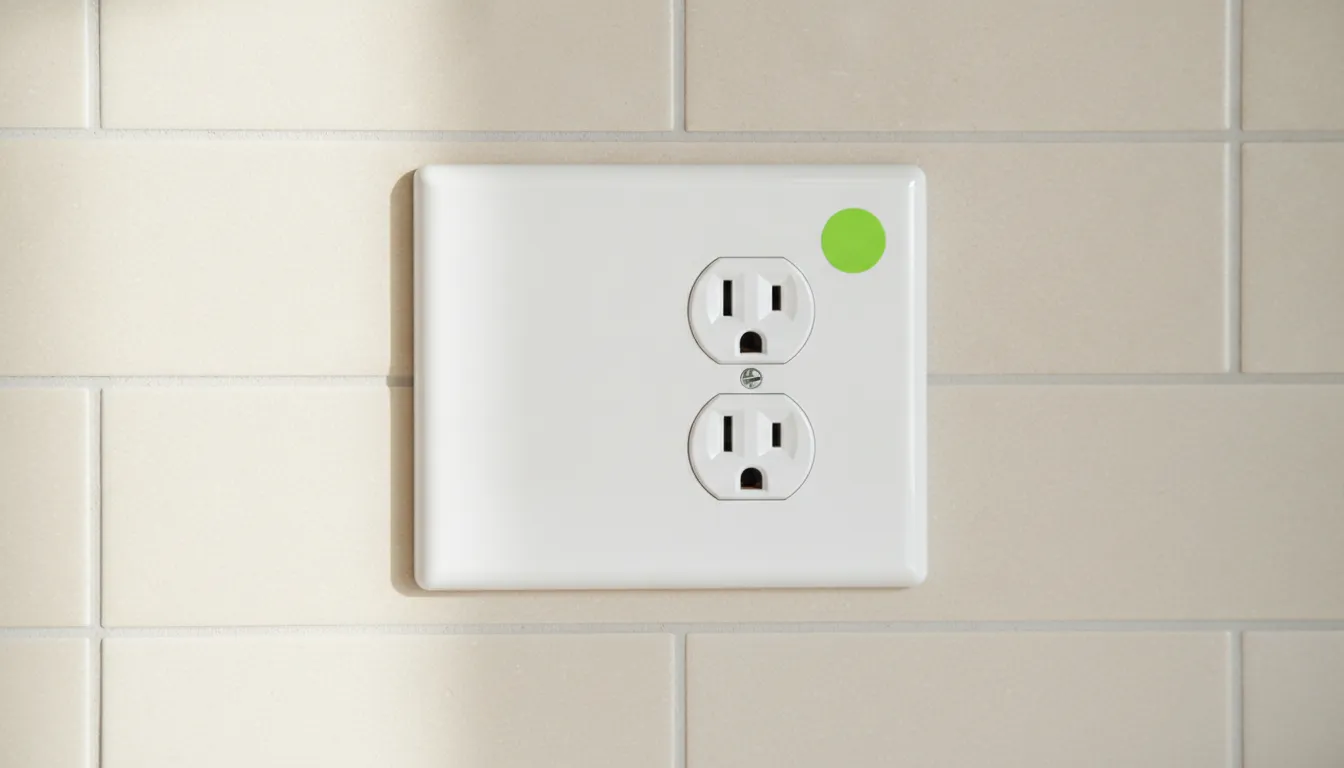
A gfci protected outlet no test button is usually a plain receptacle that borrows protection from another device. The buttons live on the first GFCI outlet on that circuit, or on a GFCI breaker in the panel. Power at the plain outlet does not prove the protection still works. You have to find the device that actually has TEST and RESET, then see whether pressing TEST kills power at the plain outlet too.
People notice this after a remodel, a home inspection, or a sticker that does not match the faceplate. The outlet works. A toaster or a phone charger runs. Nothing on the face says TEST. The useful question is which device is supposed to shut that outlet off during a ground fault, and whether that device still does it.
Call 877-762-7483 to schedule outlet and GFCI service if you cannot find the protecting device, or if TEST does not cut power at the plain outlet you use. View outlet and GFCI service.
Why a Protected Outlet Can Have No Buttons
Homeowners on the Treasure Coast run into this in kitchens, baths, garages, and on covered patios. One receptacle has the familiar buttons. The next one looks like every other outlet in the house, yet a small sticker says GFCI Protected. That second outlet is not a broken GFCI. It is a standard receptacle wired downstream of a device that can shut the circuit off. When the search fails, electrical services from a licensed crew are the next step, not another sticker.
There are two common setups. In the first, one GFCI receptacle protects itself and every outlet after it on the same run. In the second, a GFCI breaker in the panel protects the whole circuit, so none of the wall outlets need buttons. Safe Electricity's GFCI overview describes both the receptacle type and the breaker type. A portable GFCI cord is a third, temporary option for tools. It is not a stand-in for a permanent outlet in a Florida home.
The sticker is a clue, not a test. Labels fall off, get painted over, or were never applied. An outlet can also be labeled and still be unprotected if someone later replaced the upstream GFCI and landed the wires on the wrong terminals. Treat the label as a hint about where to look.
Age makes the face even less reliable. Some older receptacles used smaller buttons, or a single button that did two jobs. A decorator-style plate can also hide a device that is not a GFCI at all, including a USB opening or a night-light. Look for the words TEST and RESET before you decide the outlet has no buttons. Color alone is a weak clue, because some faces are all white.
Florida houses add one more wrinkle. A porch or garage outlet may be protected by a GFCI inside the house, where the device stays drier. The outside opening then looks ordinary, sometimes under a weather cover. The cover is not the protection. If you only inspect the exterior face, you will miss the device that actually trips.
| What you see. | What it usually means. | Where the test lives. |
|---|---|---|
| Two buttons on the outlet face. | This receptacle is the GFCI device. | Press TEST on this outlet. |
| No buttons, and a sticker says GFCI Protected. | A device upstream is supposed to protect it. | Another outlet on the run, or the panel. |
| No buttons and no sticker, in a wet area. | Protection may be missing, or the label is gone. | Search the room, then the panel, before assuming it is safe. |
| No wall buttons, and the breaker has a TEST button. | The breaker protects the outlets on that circuit. | The breaker in the panel. |
This lookup is different from deciding whether a new GFCI should be installed, and different from pricing a replacement. If the plain outlet is dead, hot, or sparking, stop the search and treat it as a repair.
How to Find the Device That Protects It
Start at the outlet that confused you. Confirm it really has no TEST or RESET. Some older devices tuck a small button along the center, or the buttons are the same color as the face and easy to miss in dim light. A phone flashlight is enough. Do not remove the cover plate to hunt for buttons.
Then search in a short radius. Protection is almost always on the same circuit, and usually in the same room or the next one over:
- Other countertop or backsplash outlets in the same kitchen.
- The outlet inside the cabinet the disposer or dishwasher uses, if you can see it without moving the appliance.
- The bathroom outlet next to the sink, including a half-bath on the same wall.
- A garage, laundry, or exterior outlet that shares the run.
- The electrical panel, if no receptacle in the area has buttons.
Plug a lamp or a night-light into the plain outlet and turn it on. Walk to each candidate GFCI and press TEST. If the lamp goes dark, you found the protecting device. Press RESET only after the test, and only if the button resets firmly and the lamp returns. If RESET will not stay in, leave it and call. Forcing it does not restore protection.
When no receptacle changes the lamp, look at the panel from a dry floor with the door open and your hands off the breakers. A GFCI breaker is usually a wider breaker with its own TEST button. You do not need to name the circuit yet. You only need to see whether any breaker has that button. If water is on the floor, you smell heat, or the panel is warm, close the door and stop.
Kitchens are the messiest version of this search. One GFCI near the sink may protect outlets along the counter, while a refrigerator outlet may be on a separate circuit. Do not assume it is either protected by the nearby GFCI or exempt from protection requirements. Do not unplug it as part of this test. Use the lamp in the unlabeled outlet instead.
Work one candidate at a time and put each GFCI back on RESET before you try the next. If you leave two devices tripped, you will not know which press killed the lamp. Write down the room and the wall when the lamp goes dark. That note is what you want later if the same outlet dies again and you are not standing there with the lamp.
Half-baths and garage corners are easy to skip. A GFCI can sit behind a door, under a towel bar, or just above a workbench. Check those before you open the panel. Also check an outlet that looks newer than the rest of the room. Remodel work often added one GFCI and left the older openings plain on purpose.
If several plain outlets die together when you press one TEST button, they share that device. You do not need a separate GFCI face on each of them for the test to count. You do need the lamp to go dark at the specific outlet you care about. A neighbor outlet going dark is not enough if yours stays lit.
How to Test a GFCI Protected Outlet With No Button
Once you know which device feeds the plain outlet, the test is the same one you would run on a buttoned receptacle. The difference is that you watch the plain outlet, not just the device you pressed.
- Plug a lamp into the outlet that has no buttons and switch the lamp on.
- Press TEST on the upstream GFCI outlet or GFCI breaker.
- Confirm the lamp goes out. That is the pass for this outlet.
- Press RESET and confirm the lamp comes back.
- If the lamp stays on after TEST, the plain outlet is not protected by that device.
The U.S. Consumer Product Safety Commission GFCI fact sheet tells owners to use the test button so the device proves it can open the circuit. A click without a dead lamp is not a pass. Power that stays on means the outlet is fed from somewhere else, or the GFCI is not actually protecting the downstream wires.
Test outlets you use near water about once a month, and after a storm outage. Florida humidity and salt air are hard on devices in garages, porches, and baths. A GFCI can still deliver power after its sensing circuit has failed. That is why the lamp test matters more than a sticker.
Skip the test if the outlet, the GFCI, or the panel shows scorch marks, a cracked face, or a burning smell. Also skip it if pressing TEST trips a different room than you expect and you cannot get RESET to hold. Those are repair visits, not monthly checks.
Use a lamp, not a hair dryer or a power tool, for the check. A small lamp tells you whether power dropped, and it does not add a heavy load while you are only testing the trip. Unplug the lamp before you press RESET if the outlet is crowded. Then plug it back in and confirm the light returns. That second look catches a RESET that clicks but does not actually close.
After a storm, test the wet-area outlets you actually use. Salt air and humid garages along the Treasure Coast age the mechanism even when the face still looks clean. If TEST does nothing, or the lamp stays on, stop repeating the press. Write down which device you tried. That is the detail a technician needs on the visit.
When the Label and the Test Disagree
Three test results should change what you do next, because each one points to a different fault.
The lamp stays on no matter which GFCI you press. The outlet may be on a normal breaker with no ground-fault protection. In a kitchen, bath, garage, laundry, or outdoor location, that is worth a licensed look. Do not add a sticker to make it match the other outlets.
TEST cuts the lamp, but RESET pops back out. The device sees a fault, a worn mechanism, or a wiring problem. Unplug portable appliances on that run and try RESET once. If it will not hold, stop. Repeated trips are a separate problem from a missing button, and the GFCI outlet keeps tripping guide covers appliance checks and when a device will not stay reset.
You find a GFCI breaker, and TEST kills several rooms at once. That can be normal for a breaker-fed circuit. Note which rooms went dark so you can tell the electrician. Do not flip neighboring breakers to "see what else is on there."
A plain outlet that sparks, will not hold a plug, or feels hot is not a labeling issue. Leave it alone and use the signs of a bad outlet list to decide how urgent the call is. Heat and arcing are not fixed by finding an upstream TEST button.
Another mismatch is a new opening with no label at all. A countertop outlet added during a kitchen update, or a porch outlet added for holiday lights, can land on a normal breaker. It will run a charger and still give you no place to press TEST. Do not assume the nearest bathroom GFCI covers it. Prove it with the lamp, or have the circuit traced.
Painted faces cause a quieter version of the same problem. A TEST button buried under latex will not travel, so the device cannot open. If the button feels sealed or the face is thick with paint, do not dig it out with a knife. That outlet needs a replacement device, not a harder push.
What to Leave to a Licensed Electrician
Finding the upstream device is a homeowner check. Opening boxes, moving line and load wires, and swapping a breaker are not. My Electrician, Inc. handles outlet and GFCI work from Port St. Lucie across the Treasure Coast, with employed technicians, upfront pricing, and a written workmanship guarantee.
Call for outlet service when any of these show up in the house and the lamp check cannot clear them:
- No GFCI outlet or GFCI breaker will kill power at a wet-area receptacle.
- The protecting device will not reset, or it resets and trips again right away.
- You need a new receptacle, a replacement GFCI, or a breaker identified in the panel.
- An addition, a new countertop, or a porch outlet was added and never labeled.
- You are buying a home and want the unlabeled outlets checked before closing.
A proper visit confirms which device protects which openings, replaces a worn GFCI when the test fails, and labels the downstream outlets so the next person is not guessing. That is outlet service, not a panel replacement and not a whole-house rewire. If the search shows a breaker problem rather than an outlet problem, the circuit breaker repair service is the right desk.
On the visit, say which plain outlet you tested and which device you pressed. A photo of the outlet face and a photo of the GFCI or breaker you used is enough. You do not need to pull a cover or name the wire colors. The technician confirms the path, replaces a device that will not trip or reset, and can mark the downstream openings so the next test is faster.
For the broader question of what a buttoned GFCI does and where new ones belong, use the GFCI outlet installation guide. Kitchen-specific rules live in the kitchen GFCI outlet guide. This page stays on the outlet that has no buttons of its own.
Request a Treasure Coast outlet visit, or call 877-762-7483, if the lamp stays on after every TEST press.
Frequently Asked Questions
Can an outlet be GFCI protected with no test button?
Yes. A standard receptacle can be fed from a GFCI outlet earlier on the circuit or from a GFCI breaker. The plain outlet will not have TEST or RESET. Protection depends on that other device still working.
How do I test a GFCI protected outlet with no button?
Plug in a lamp and turn it on. Press TEST on the upstream GFCI outlet or on the GFCI breaker. The lamp should go out. Press RESET and the lamp should come back. If the lamp never goes out, that device is not protecting the outlet.
What does a GFCI Protected sticker mean?
It means someone marked that opening as downstream of a GFCI. The sticker is not proof. Paint, remodel work, or a wrong wire landing can leave the label in place after protection is gone. Confirm it with the lamp test.
Why did the other bathroom outlet go dead when I pressed TEST?
That is the usual pattern. One GFCI often protects the other receptacles on the same run. Reset the device you pressed. If those outlets stay dead, or RESET will not hold, stop cycling the button and schedule service.
Is a missing test button the same as a bad outlet?
No. Many safe outlets have no buttons because protection sits upstream. A bad outlet shows heat, sparks, a loose plug, scorch marks, or power that flickers. Those symptoms need repair even if a nearby GFCI tests fine.