
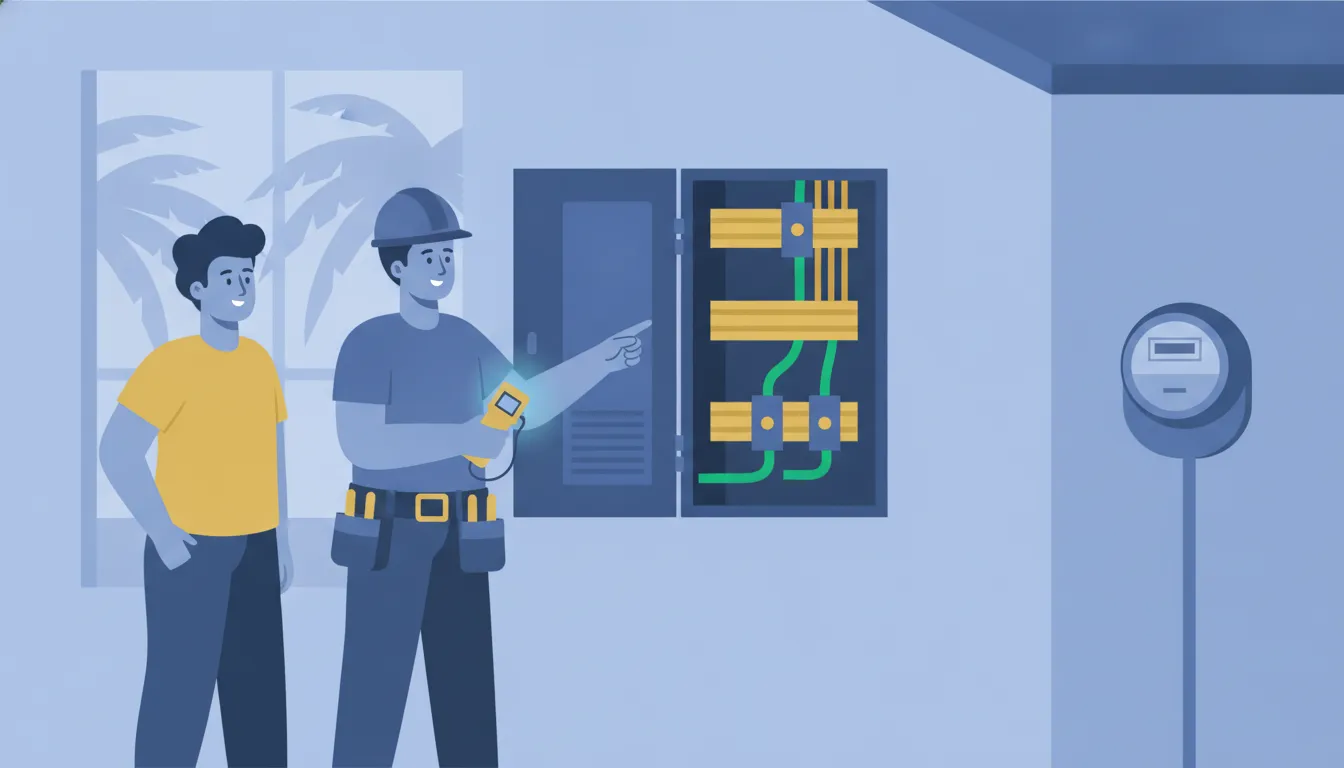
Lights that flicker or breakers that trip repeatedly are reasons to pause. An outlet that sparks is also a warning. Do not investigate by opening an electrical panel. These symptoms can have several causes. A qualified inspection is the safest way to understand what is happening.
Grounding and bonding are different parts of a home's electrical safety system: grounding connects the electrical system to the earth. While bonding connects exposed conductive metal parts so fault current has a safer path. They work together, but neither one is a reason for a homeowner to alter wiring or make pool electrical changes.
Understanding that distinction makes electrical recommendations easier to evaluate, especially after storm damage, remodeling, panel work, or unexplained electrical symptoms. Start with the basic jobs each system performs and why confusing them can leave an important safety question unanswered.
Schedule Service with My Electrician FL to discuss an electrical inspection.
What Do Grounding and Bonding Mean in a Home?
If you hear an electrician mention grounding and bonding, the terms can sound interchangeable. They are related, but they describe different jobs in a home electrical system. Grounding connects the electrical system to the earth. Bonding connects exposed conductive metal parts so they remain at a consistent electrical potential and can support a safe path when a fault occurs.
What does grounding do?
Grounding is the connection between a bonded electrical system and the earth. It helps stabilize voltage to earth during normal operation and provides a path for certain abnormal events. Such as lightning, line surges, or accidental contact with an overhead line. The electrical grounding and bonding overview from Electrical Construction & Maintenance explains that grounding serves both voltage-limiting and voltage-stabilizing purposes.
In a typical home, grounding may involve the service equipment, grounding electrode system, grounding electrode conductor, and equipment grounding conductors. The exact arrangement depends on the property's wiring, service configuration, equipment, and applicable code requirements. A grounding connection does not make every electrical event harmless. And it is not a substitute for properly installed overcurrent protection, GFCI protection, surge protection, or safe electrical practices.
What does bonding do?
Bonding creates electrical connections among conductive metal parts that are not intended to carry current during normal operation. These parts can include metal equipment enclosures and other components addressed by the electrical system's grounding and bonding requirements. If a fault energizes a metal part, bonding helps connect that part to the equipment grounding path so protective equipment has a path to respond.
For a homeowner-friendly definition, Home Depot's grounding versus bonding guide describes grounding as attaching bonded systems to the earth and bonding as connecting exposed metal items that are not designed to carry electricity. That distinction is useful: grounding addresses the relationship between the system and earth, while bonding addresses the relationships among conductive parts within the electrical system.
Both functions matter, but neither should be treated as a guarantee against shocks, fires, lightning damage, or surges. Grounding and bonding must be correctly designed, connected, and maintained for the specific home. If a property has older wiring, repeated breaker trips, damaged equipment, storm damage, or other unexplained electrical symptoms. A qualified electrician can test the system rather than relying on the appearance of a ground wire or a receptacle.
How Do Grounding and Bonding Work Together During a Fault?
Imagine a wire inside an appliance loosens and touches its metal case. The case may not be carrying current during normal operation, but it can become energized during that fault. This is where grounding and bonding perform different jobs that must work together.
Bonding connects exposed metal parts so they remain at a similar electrical potential and so fault current has a deliberate route through the equipment grounding path. The equipment grounding conductor can carry fault current back toward the source, allowing the fuse or circuit breaker to open the circuit. In plain terms, the goal is to help protective equipment respond quickly instead of leaving a metal surface energized. The electrical grounding and bonding overview from ECM explains how equipment bonding and an effective ground-fault current path fit into this safety function.
Grounding addresses the system's relationship with earth. Electrical systems are grounded to help limit voltage imposed by lightning, line surges, or accidental contact with overhead lines. Grounding also helps stabilize voltage to earth during normal operation. It is not a guarantee that a home will be unaffected by every surge or electrical event, but it is an important part of a properly designed system.
That distinction matters during a fault. Bonding helps make the metal parts and fault-current path behave as an intentional system. Grounding supports the system-to-earth relationship and helps manage certain abnormal voltages. Together, these paths help electrical protective devices do their job and reduce the chance that fault energy remains on equipment that someone may touch. The NEC's grounding and bonding requirements exist because the two functions work together to reduce hazards and support protective operation, as summarized by Erie Institute of Technology.
Lightning and surges require realistic expectations. A grounding system can provide a conductive path for events such as lightning, accidental contact, static charges. And surges, and grounded equipment may direct discharge toward earth rather than toward sensitive equipment or people. However, grounding alone does not make a home surge-proof or eliminate the need for properly selected surge protection. A qualified electrician can evaluate the complete system, including bonding connections, grounding conductors, service equipment, and protective devices.
Because the neutral-to-ground connection is limited to approved locations, the main bonding connection is not something to relocate or duplicate casually. Electrical grounding and bonding guidance from The Training Center notes the importance of the main service bonding point. If breakers trip repeatedly, metal equipment gives you a shock, or storm activity is followed by unusual electrical behavior. Schedule a professional inspection rather than opening the panel or attempting a repair.
What Warning Signs Should Make You Request an Inspection?
Electrical symptoms are a reason to ask questions, not a diagnosis you should make from the outside. Flickering lights, repeated breaker trips, dead outlets, or a tingling sensation can have several possible causes. One of them may involve grounding or bonding, but the symptom alone does not prove that a defect exists. A qualified electrician can test the system and explain what the results mean.
Pay attention to changes you can see or feel
- Flickering or dimming lights: Occasional changes may point to a connection, circuit, load, or supply concern. If the problem is frequent, affects multiple rooms, or appears when major equipment starts, request an evaluation.
- Breakers that trip repeatedly: A breaker that trips once may respond to a temporary condition. Repeated trips, especially without an obvious change in use, deserve professional troubleshooting. Do not keep resetting it if it trips again.
- Tingling or shocks: A shock from an appliance, faucet, switch, or other metal surface should be treated seriously. Stop using the equipment if it is safe to do so, keep others away, and contact an electrician.
- Dead outlets or switches: An outlet that stops working may reflect a tripped protective device, damaged wiring, a failed receptacle, or another circuit issue. Avoid removing the cover to investigate.
- Sparks, burning smells, or heat: Sparking, discoloration, unusual warmth, buzzing, or a burning odor around an outlet, switch, or panel calls for prompt attention. If there is smoke or an active fire, leave the property and call emergency services.
When the panel, weather, or environment raises concern
Panel failures, visible damage, water intrusion, storm or lightning events, and corrosion are also sensible triggers for an inspection. Homes in coastal Florida may face humidity and salt-air exposure that affect outdoor or marine electrical equipment over time. A storm can create damage that is not immediately obvious, so unexplained outages or new electrical behavior afterward should not be ignored.
These signs do not confirm a grounding or bonding problem, and grounding and bonding do not prevent every electrical event. They do justify having the service, panel, conductors, protective devices, and relevant connections evaluated with appropriate instruments. For more symptom examples, review these warning signs of electrical problems, then request professional guidance rather than opening a panel or testing energized parts yourself.
When Should You Schedule a Grounding and Bonding Inspection?
Some electrical concerns appear during a major change, while others show up as symptoms you cannot explain. An inspection is a sensible next step when the home, its electrical demand, or its surroundings have changed. It can identify conditions that deserve attention without assuming that every flickering light or tripped breaker means the grounding system has failed.
Consider scheduling a professional evaluation in these situations:
- You are buying, remodeling, or adding to the home. A pre-purchase inspection, major renovation, room addition, or finished-space conversion is a useful time to review the service, panel, grounding, and bonding systems. Remodeling may change circuit demands or expose older work that should be documented before the project continues.
- You are adding a panel or a major electrical load. A panel change, generator, large appliance, workshop equipment, or other substantial load should be evaluated as part of the broader electrical system. The inspection can help determine whether the existing installation, connections, and protective equipment are appropriate for the planned work.
- Breakers keep tripping, you feel shocks, or symptoms recur. Repeated breaker trips, flickering lights, dead outlets, sparking switches, or a mild shock from equipment are reasons to stop guessing and request qualified troubleshooting. These symptoms do not prove a grounding or bonding defect, but they should not be ignored. Review additional warning signs of electrical problems if you are unsure how quickly to seek help.
- The property has experienced a storm, lightning event, or water-related damage. Florida weather can expose electrical equipment to lightning, surges, moisture, and other stress. After noticeable storm damage or unusual electrical behavior, an electrician can assess the installation and discuss related protection, including whole-house surge protection, when appropriate.
- The wiring or electrical equipment is older. Older homes may have additions, alterations, or components that no longer match current needs. An evaluation is especially worthwhile when documentation is missing, previous work is unclear, or the property has never received a comprehensive electrical review.
- You are installing or renovating a pool or spa. Pool bonding is a distinct professional safety category and should be evaluated alongside the related electrical work. Do not attempt to inspect or alter pool electrical systems yourself. A qualified electrician can review the installation without asking you to open panels or work near energized equipment.
A professional inspection typically combines a visual evaluation with load testing, voltage checks, grounding verification, and examination of relevant connections and equipment. The electrician may use meters, circuit analyzers, thermal imaging, or other diagnostic tools when the situation calls for them. Findings should be documented in writing, explained in plain language, and reviewed against the National Electrical Code and applicable local requirements. Exact code application depends on the property and the work involved.
For a structured starting point, use this electrical safety inspection checklist, then schedule an electrical inspection when a concern, project, or unexplained symptom warrants professional evaluation.
Is Pool Bonding the Same as Home Electrical Grounding?
A pool or spa can introduce a safety question that is easy to confuse with the electrical grounding in a house. They are related parts of a broader electrical safety plan, but they are not interchangeable. Home service grounding connects the electrical system to the earth and helps provide a path for certain fault and surge conditions. Pool bonding addresses conductive parts in and around a pool or spa environment so that those parts remain at a more consistent electrical potential.
That distinction matters because pool areas combine electricity, water, metal equipment, and people who may be barefoot or wet. Pool bonding is a specialized safety concern, not a simple extension of the home's grounding arrangement. A pool or spa project, renovation, equipment change, or unexplained shock sensation near the water should be evaluated by a qualified professional. Homeowners should not open electrical equipment, alter connections, or attempt to test or install bonding components themselves.
| System | Plain-English purpose | When to call a professional |
|---|---|---|
| Home service grounding | Connects the home's electrical system to earth and supports a safe response to certain faults and surges. | After panel or service changes, storm damage, recurring electrical symptoms, or concerns about the home's grounding. |
| Equipment grounding | Helps connect exposed metal parts of electrical equipment to a fault-current path so protective devices can respond. | When outlets, appliances, panels, or other equipment show damage, sparking, shocks, or unexplained operation. |
| Pool and spa bonding | Helps keep conductive parts around the water environment at a similar electrical potential. | Before or during pool construction, remodeling, equipment replacement, or whenever anyone feels a shock or tingling near the water. |
Florida's storms, humidity, and salt air can make outdoor electrical conditions especially important to review. But an inspection is the only reliable way to determine whether a concern involves grounding, bonding, damaged equipment, or another issue. If you are planning pool work or have noticed a warning sign, describe what happened and have the complete system assessed. Do not assume that a home's service grounding confirms that pool bonding is correct.
What Grounding and Bonding Work Should Homeowners Leave to an Electrician?
Grounding and bonding work can look straightforward from the outside, but the safety outcome depends on how the entire electrical system is arranged. A panel, service equipment, grounding electrode system, conductors, receptacles, and connected equipment must work together. A mistake in one location can create an unsafe current path or leave a fault without the protection it needs.
Panel and conductor work requires system-level judgment
An electrician can identify which conductors serve which purpose, evaluate terminations, and check whether equipment grounding conductors are connected appropriately. This distinction matters because grounded conductors and equipment grounding conductors have different roles. OSHA requires each type to be identifiable and distinguishable from other conductors, and says receptacle grounding contacts should connect to the equipment grounding conductor supplying the circuit. See the OSHA conductor and receptacle requirements.
Homeowners should not open a panel to adjust a neutral-ground connection, add a conductor, or troubleshoot equipment that may remain energized. The correct connection point depends on the service arrangement, the equipment, the existing wiring, and the applicable code. A qualified electrician can evaluate those conditions rather than applying a one-size-fits-all fix.
Grounding electrodes and bonding connections are not guesswork
Grounding electrode conductors and equipment grounding conductors are selected and connected according to the system and protective equipment they serve. The National Electrical Code addresses grounding and bonding in Article 250, including grounding electrode systems, bonding, approved connection methods, and effective fault-current paths. The Article 250 overview from Electrical Construction & Maintenance also notes that the rules include numerous exceptions and can be difficult to apply.
That is why an electrician checks more than whether a wire or rod is present. Professional evaluation may include visual inspection, voltage checks, load testing, circuit analysis, and verification of grounding and bonding continuity. The findings can then be compared with the home's configuration, current code requirements, manufacturer instructions, and local requirements. Exact application depends on the property and the code in effect when the work is performed.
Pool-related work deserves a separate safety evaluation
Pool and spa electrical work is a distinct professional category. Pool bonding should not be treated as a simple extension of the home's service grounding, and it should never be improvised by a homeowner. An electrician can review the pool equipment, surrounding conductive components, existing electrical system, and applicable requirements before recommending work.
Leaving these tasks to a qualified professional protects more than the equipment. It helps ensure that any repair or upgrade is documented, tested, and explained clearly before the system is returned to normal use.
Frequently Asked Questions
What are the NEC requirements for grounding and bonding?
Requirements depend on the home's wiring, service equipment, property conditions, and current local code. NEC Article 250 addresses grounding and bonding, including grounding electrode systems, grounding conductors, and bonding provisions. A qualified electrician should evaluate the installation rather than applying a one-size-fits-all fix. See the NEC Article 250 overview for general background.
What are the signs of poor grounding?
Flickering lights, repeated breaker trips, dead outlets, sparking, storm-related electrical problems, or panel issues are reasons to request an inspection. These symptoms do not prove a grounding defect, because several electrical problems can look similar. Do not open the panel or test energized equipment yourself, especially if you notice heat, smoke, burning odors, or active sparking.
What is the purpose of bonding?
Bonding connects exposed metal parts that are not intended to carry current, helping keep them at a similar electrical potential. If a fault energizes metal, a properly designed bonded path can help protective equipment respond. Bonding does not replace grounding; the two systems perform different jobs and work together as part of electrical safety.
How are grounding and bonding evaluated?
An electrician can use professional meters, load tests, voltage checks, and grounding verification, then document findings and review the installation against applicable code. The correct work may involve tracing conductors, checking connections, or addressing damage, but the solution depends on the home's actual conditions. Homeowners should not install rods, alter neutral-ground connections, or work inside an energized panel.
Is pool bonding the same as home electrical grounding?
No. Pool and spa bonding is a distinct electrical safety system associated with the pool environment, while service grounding describes the home's broader electrical system. Pool work has its own equipment, conditions, and code considerations. Have a qualified professional evaluate pool bonding rather than attempting to add or change connections yourself.
Schedule an Electrical Inspection
Grounding and bonding work together as part of a home's electrical safety system, but their condition is not something to confirm by sight alone. A professional inspection can help evaluate concerning symptoms, recent electrical changes, or questions about pool and home electrical systems. Schedule an electrical inspection with My Electrician FL.