
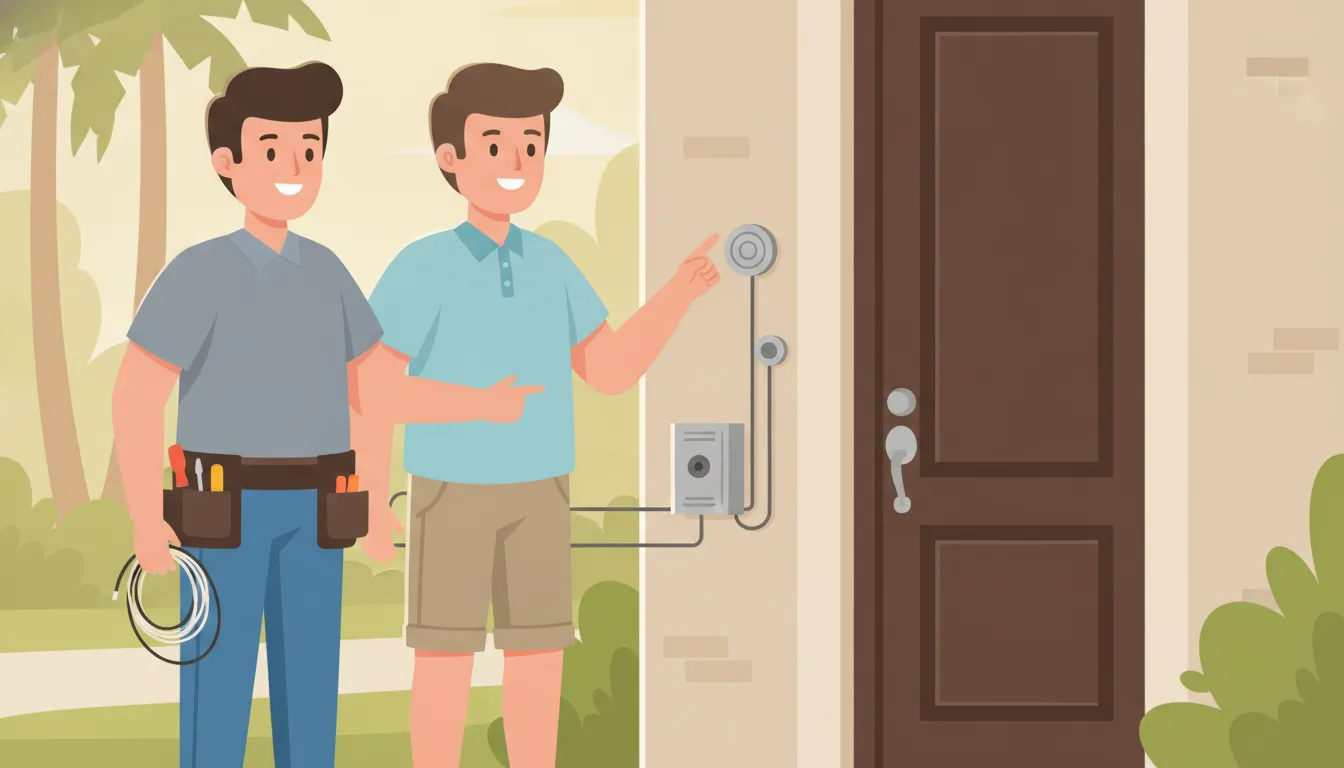
A doorbell that stays silent or rings only sometimes needs more than a quick wire swap. A video doorbell may also drop offline. The button, chime, and transformer must work together. The transformer connects the low-voltage circuit to your home's higher-voltage electrical system.
Learning how to wire a doorbell starts with identifying the existing transformer and checking the specific doorbell's voltage, power, and chime requirements. A simple low-voltage connection may be within a confident homeowner's limits.
Transformer work, damaged or concealed wiring, exposed conductors, sparking, burning odors, and repeated breaker trips call for an electrician.
Before touching any terminals, follow the manufacturer's instructions and verify the circuit is de-energized. Understanding what each part does makes it easier to spot an ordinary connection problem and recognize when the circuit needs professional testing. Start by looking at the components that create the wired doorbell circuit.
Schedule Electrical Repair for doorbell wiring, transformer, or low-voltage troubleshooting.
What Parts Make Up a Wired Doorbell Circuit?
When a wired doorbell works, pressing the button completes a small electrical loop that makes the chime sound. The system has three primary components: a transformer, a push button, and a chime. Low-voltage wiring connects these parts, while the transformer connects the doorbell circuit to the home's electrical supply.
The transformer reduces power for the doorbell circuit
The transformer changes household electrical power to a lower voltage for the doorbell wiring. That is why the wiring at the button and chime is different from the line-voltage wiring used elsewhere in the home. The transformer may be near the electrical panel, in an attic, or close to the chime, so its location is not always obvious. Because transformer work can involve the home's higher-voltage system, do not assume that every part of the circuit is safe to handle just because the doorbell itself uses low voltage.
The button starts the circuit
The push button acts like a switch. When someone presses it, the contacts close and allow current to travel through the circuit. Releasing the button opens the circuit again. A loose connection, damaged conductor, or worn button can therefore leave the chime silent or make it ring intermittently. Wire colors and terminal layouts can vary, so follow the device manufacturer's instructions rather than treating one diagram as universal.
The chime produces the sound
The chime is the indoor component that converts the electrical signal into the familiar doorbell sound. In a basic arrangement, one wire runs from the transformer toward the button, another connects the button to the chime, and a return path completes the loop back to the transformer. A second button or a video doorbell can change that arrangement, especially if the chime needs a bypass or another device-specific accessory.
Understanding these parts can make troubleshooting less confusing. For a broader explanation of low-voltage electrical systems, review the related homeowner guide, and always stop if you find exposed conductors, heat, burning odors, or wiring connected directly to line voltage.
How Do You Match a Transformer to a Doorbell?
A silent chime or video doorbell that repeatedly drops offline can make the transformer seem like the obvious culprit. The safer approach is to start with the exact doorbell model and its installation documentation. Transformer output is not a universal choice, and using a component that does not meet the device's requirements can create unreliable operation or damage the equipment.
Check voltage and power requirements together
Read the doorbell manufacturer's specifications for the required voltage and power capacity. Some devices identify voltage only, while others specify a volt-amp requirement as well. Those details describe what the doorbell needs from its supply, not a general recommendation that applies to every wired or video model. Requirements can vary between brands and models, so do not select a transformer based only on what was installed for an older button.
Video doorbells can be especially sensitive to an incorrect match. A device may need steady wired power for its camera, notifications, or other features. A transformer with an unsuitable output can contribute to intermittent operation, unexpected resets, or other symptoms that look like a problem with the doorbell itself. The cited installation guidance also warns that transformer output may behave differently when the device is not drawing its normal load, which is another reason not to guess from a label alone.
Account for the chime and the complete circuit
Matching the transformer means considering the entire setup, including the existing chime, button, wiring, and any video doorbell accessory supplied by the manufacturer. A wired chime can change how a video doorbell is connected. Some models require a chime bypass, while others use a manufacturer-supplied module or a model-specific component when the existing chime is absent or unsupported. Follow the instructions for that exact device rather than copying a diagram from another brand.
Before replacing anything, document the current connections and inspect for loose, damaged, or concealed wiring. If the transformer is mounted at or inside the electrical panel, stop instead of treating the work as a simple low-voltage swap. A professional can test the circuit and check for voltage drops or intermittent faults as part of an electrical repair assessment. Installation should follow the manufacturer's specifications, the National Electrical Code, and applicable local requirements.
What Symptoms Point to Low-Voltage Doorbell Wiring Trouble?
A silent chime is the most obvious warning, but it is not the only clue that a doorbell circuit needs attention. You may hear the chime ring only sometimes, notice a video doorbell repeatedly going offline, or see its status light flicker. These symptoms can appear after a device change, a storm, or gradual wear, but the symptom alone does not identify the cause.
Watch for changes in sound, power, or operation
Pay attention to patterns rather than assuming the button or camera is defective. A chime that works from one button but not another may point to a problem somewhere along that part of the circuit. A video doorbell that disconnects, reboots, or flickers may not be receiving stable power, or its setup may not match the existing transformer and chime. Follow the device manufacturer's troubleshooting guidance before changing connections.
Also look and listen for warning signs around accessible equipment.
- A silent, intermittent, or unusual chime.
- A video doorbell that goes offline, flickers, or restarts.
- Warmth, burning odor, discoloration, or damaged insulation.
- Sparking, exposed conductors, or a tripping breaker.
Why testing matters
These observations can suggest a wiring, component, power, or connection issue, but they do not confirm one remotely. A technician may need to test the circuit, check for voltage drops or intermittent shorts, and inspect terminations without unnecessarily opening walls. My Electrician describes advanced meters and load tests as part of electrical troubleshooting, where appropriate. This is different from simply guessing which wire belongs on which terminal.
Do not continue experimenting if you find heat, sparking, a burning smell, damaged insulation, exposed wiring, or repeated breaker trips. The doorbell side is generally low voltage, but its transformer connects with the home's electrical system. If you need broader context on low-voltage electrical systems, review the related homeowner guide. For an uncertain or recurring fault, arrange testing rather than treating a symptom as a diagnosis.
How Can You Wire a Standard Doorbell Safely?
If your existing doorbell has stopped ringing, replacing the button or reconnecting low-voltage conductors may be manageable in a limited situation. The transformer is different: it connects the doorbell circuit to the home's line-voltage electrical system. Do not open an electrical panel or work on transformer connections unless you are qualified to do so. Use these steps only for a clearly identified, existing standard doorbell circuit, and stop whenever the wiring or power source is uncertain.
- Identify the components without removing anything. A wired system generally includes a button, a chime, and a transformer. Look at the chime and button first. Note where each wire is attached and take a clear photo before disconnecting a conductor. Do not assume wire colors, terminal labels, or voltage ratings are universal. A transformer may be near a panel, in an attic, or near the chime, so do not pull apart an unfamiliar device just to locate it. If you see exposed conductors, damaged insulation, corrosion, scorching, or an unknown power source, stop and call an electrician.
- Read the product instructions before matching connections. Follow the doorbell and chime manufacturer's wiring diagram, terminal labels, and compatibility requirements. Some chimes use labels such as Front, Trans, or Back, but the correct connections depend on the equipment. If the replacement part has different instructions, does not match the existing circuit, or is a video doorbell, do not improvise a connection. Smart devices may require model-specific power capacity or a chime bypass.
- Turn off the correct breaker. Before removing a button, chime cover, or low-voltage wire, switch off the breaker supplying the doorbell transformer. Do not rely on the doorbell being silent as proof that power is off. If you cannot confidently identify the circuit, stop rather than guessing. A qualified electrician can identify the circuit safely. Never remove a panel cover or touch line-voltage terminals.
- Verify that the work area is de-energized. Use an appropriate tester according to its instructions, and check before touching conductors. If the test result is unexpected, inconsistent, or difficult to interpret, stop. Do not proceed around sparking, heat, a burning odor, repeated breaker trips, or energized wires. These are not normal doorbell-installation conditions.
- Reconnect only the clearly documented low-voltage conductors. Keep the conductors secure, avoid damaging their insulation, and follow the manufacturer's diagram exactly. Do not enlarge openings, run concealed cable, replace a transformer, or alter line-voltage wiring as part of a simple button or chime replacement. Those tasks require an electrician's assessment and may involve code requirements.
- Restore power and test only when everything is secure. Replace covers, keep hands and tools clear, and restore the breaker only if no unsafe condition was found. Test the button and chime from a safe position. Turn the breaker off again and stop if the chime remains silent, operates intermittently, becomes hot, or causes the breaker to trip. A professional can use meters and load tests to locate voltage drops or intermittent faults without unnecessarily opening walls. Schedule Electrical Repair when the cause is not obvious or the work exceeds this narrow low-voltage boundary.
How Does Smart Doorbell Wiring Differ?
The basic question of how to wire a doorbell changes when the button also contains a camera, Wi-Fi radio, motion sensor, and computer. A traditional wired doorbell usually sends power through a simple button-and-chime circuit. A wired smart doorbell may need steady power, a compatible transformer, and a specific chime configuration. A battery or plug-in model can reduce the amount of in-wall wiring, but it still has installation limits that depend on the product.
| Doorbell type | Power arrangement | Chime and wiring considerations |
|---|---|---|
| Traditional wired | A low-voltage transformer supplies the button and chime circuit. | The existing chime and terminal arrangement typically remain part of the circuit. Confirm the equipment instructions before changing connections. |
| Wired smart or video | Requires continuous power within the voltage and power-capacity range specified for that model. | The mechanical chime may need a compatible adapter, bypass, or other configuration. Some installations may call for a resistor, but that is not universal. |
| Battery or plug-in | Uses a rechargeable or replaceable battery, or power from an approved plug-in adapter. | It may not use the existing low-voltage chime. Battery life, outlet location, weather exposure, and the manufacturer's mounting instructions matter. |
Check the transformer before connecting a smart doorbell
Do not choose a transformer by appearance, wire color, or a rating that worked for a different device. Manufacturers can specify both a voltage range and a power-capacity requirement, and those specifications vary between models. A transformer that powers a traditional chime may not provide the continuous supply a video doorbell needs. Conversely, using a higher-capacity transformer without checking the device requirements can create an unsuitable voltage condition.
The existing chime also matters. Some wired video doorbells are designed to work with a mechanical chime, while others require the chime to be bypassed or configured with an included module. If no compatible chime is present, the instructions may call for a resistor or another component to help regulate the circuit. These parts are model-specific, so follow the doorbell manufacturer's wiring diagram rather than treating one setup as standard.
Know when the wiring is not a simple swap
If the transformer is mounted at the electrical panel, stop and have the circuit tested. Do the same if wiring is concealed or damaged. A repeatedly offline device or chime that hums or fails after installation also needs attention.
A professional can check voltage and load behavior. They can confirm transformer compatibility and verify the installation without guessing at connections.
When Should an Electrician Inspect the Doorbell Circuit?
A silent chime is not always a reason to call for service, but some doorbell problems involve more than the button or chime. Stop working and arrange an inspection if the project reaches the line-voltage side of the transformer, the electrical panel, or wiring you cannot identify. A transformer may be connected to a receptacle or directly to the panel, and panel-connected work is not a good place to experiment.
Professional help is also the safer choice when wiring disappears into a wall, insulation, an attic, or another concealed space. Exposed conductors, damaged insulation, a burning odor, sparking, unusual heat, or repeated breaker trips are stop signs. Do not keep resetting a breaker to make a doorbell operate. If you see active sparking or smell burning near the circuit, keep clear and use emergency electrical service for the urgent hazard.
Smart-doorbell symptoms deserve an inspection when the camera repeatedly goes offline, reboots, fails to ring the existing chime, or works unreliably after installation. Power requirements vary by model, and a wired chime or bypass component can affect the setup. The correct assessment starts with the manufacturer's specifications rather than assuming that an existing transformer will support a new device.
What does a professional assessment include?
My Electrician can evaluate the circuit, transformer, connections, and accessible wiring, then use meter and load testing to look for voltage drops, intermittent shorts, or nuisance tripping. This testing can help identify the problem without unnecessarily opening walls. The technician explains the findings and provides an upfront quote before work begins.
When repair or installation is appropriate, the work follows manufacturer instructions and applicable electrical requirements. The process includes safety verification after the work is complete, along with an explanation of what was changed and how to use the system. That combination of testing and education is especially useful when you are unsure how to wire a doorbell or when the existing setup has been modified over time.
The next section answers common homeowner questions about doorbell wiring and safety.
Frequently Asked Questions
Which wires go where on a doorbell?
A typical wired circuit connects the transformer to the button, the button to the chime, and the chime back to the transformer. Chime terminals may be labeled Front, Trans, and Back, but labels and layouts can vary, so follow the equipment instructions rather than relying on wire color alone.
How do you supply power to a smart doorbell?
Start with the specific model's voltage and power requirements. A video doorbell may also depend on the existing chime, a bypass arrangement, or another model-specific component. Do not assume that a transformer that powers a basic button and chime is automatically suitable for a camera.
Can you wire a doorbell yourself?
Some homeowners can replace a button or reconnect accessible low-voltage conductors, but the safe boundary is important. Turn off the relevant breaker and verify that power is off before removing a wired doorbell. Stop if the transformer is mounted at the panel, wiring is damaged or concealed, or you cannot identify the circuit.
How do you know when doorbell wiring needs professional attention?
Call an electrician for a silent or intermittent chime that persists after basic checks, a smart doorbell that repeatedly goes offline, exposed conductors, heat, burning odors, sparking, or repeated breaker trips. Testing can identify voltage drops and intermittent shorts without unnecessarily opening walls, while a professional can verify the transformer and wiring as a complete system.
How do you wire a doorbell without existing wiring?
Adding wiring may involve routing conductors through finished walls and connecting a transformer to the home's electrical supply. Because the work can cross from low-voltage wiring into line-voltage connections, have an electrician assess the route, power source, and local requirements before installation.
Schedule Service for Doorbell Wiring Help
When a doorbell stays silent, drops offline, or needs a compatible transformer, a professional check can help identify the issue without guesswork. My Electrician can evaluate the wiring, transformer, and power needs before completing safe troubleshooting or installation. Schedule Service for doorbell wiring assistance, transformer compatibility checks, or electrical troubleshooting.