
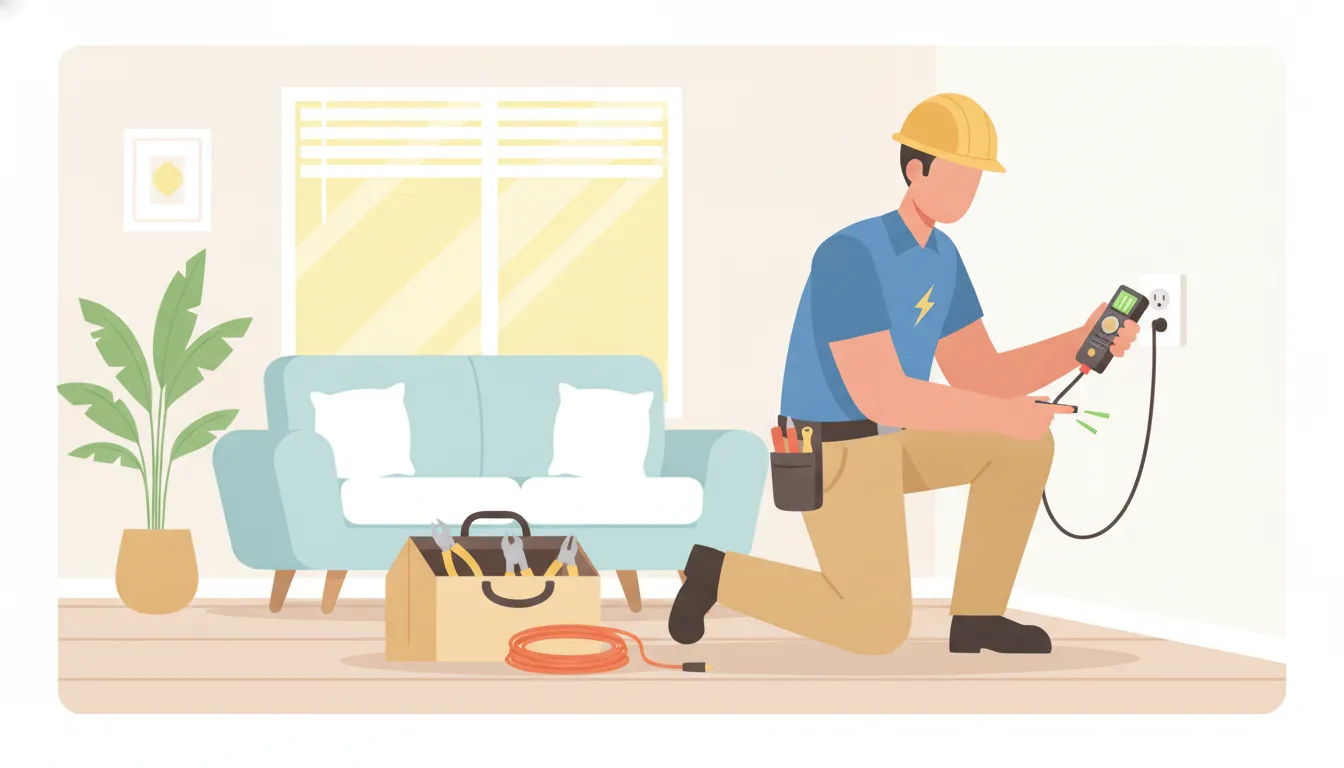
A dead, loose, or damaged outlet can look like a small repair, but the wiring behind the wall may not match what you expect. Before touching a receptacle, treat the circuit as energized until you identify the correct breaker and verify the absence of voltage with appropriate testing.
Learning how to wire receptacle outlet safely starts with matching the receptacle to the circuit, confirming the hot, neutral, and grounding conductors. Checking whether GFCI protection is needed, and stopping if the wiring, circuit identity, or grounding is uncertain.
Schedule Service for outlet installation and repair.
Compatibility matters just as much as the connections. Older or coastal homes may have aging wiring, corrosion, or other conditions that are not visible at first glance. The safest place to begin is a careful check of the existing receptacle, box, conductors, and circuit before deciding whether this is a simple replacement or work for a licensed electrician.
How do you safely wire a receptacle outlet?
A dead, loose, or damaged outlet can look like a simple replacement project. Before deciding how to wire receptacle outlet connections, first determine whether you are replacing an existing receptacle or planning a new installation. Those situations can involve different circuit conditions, box space, grounding, and protection requirements. If the outlet is warm, discolored, cracked, sparking, or associated with a burning odor, stop and arrange professional help rather than removing it.
Is this a replacement or a new installation?
A replacement starts with an existing box and circuit, but that does not guarantee the wiring is suitable for the new device. A new installation may require a new cable route, a properly sized box, circuit planning, and other work that should be evaluated on site. In either case, identify which breaker supplies the receptacle and confirm that the circuit is actually de-energized before any conductors could be exposed. Uncertainty about the circuit identity is a reason to stop, not a reason to guess.
Does the receptacle match the circuit?
Receptacles are rated for particular voltage and current conditions. A grounding-type receptacle should be installed only on a circuit with the voltage class and current rating for which it is rated, as described in the applicable OSHA electrical standard. The device also needs to suit the intended use. An outlet for ordinary household loads is not automatically appropriate for equipment that requires a dedicated circuit or different electrical characteristics.
Do not assume that a receptacle with a ground-shaped opening is grounded simply because it fits the box. Grounding contacts must be effectively grounded, and the grounding terminal is intended only for grounding. In an older two-wire system, adding a modern-looking receptacle does not by itself create an equipment grounding conductor. GFCI protection may be part of a safe solution in some replacement situations, but it does not automatically create that grounding conductor. These conditions require an electrician to assess the circuit rather than a homeowner making a visual assumption.
What condition are the box and conductors in?
Look for signs that the existing box or wiring may need more than a device swap: brittle insulation. Exposed copper, corrosion, loose connections, heat damage, overcrowding, or conductors that are too short to work safely. Coastal homes and older properties may also have added concerns from aging wiring, humidity, salt-air corrosion, or previous repairs. Do not proceed if the wiring type is unknown, aluminum wiring is present, the box is damaged, or the grounding path is unclear.
For homeowners in Port St. Lucie and across the Treasure Coast, outlet installation and repair can include evaluating damaged conductors, terminations, and grounding rather than simply installing a new cover. A professional assessment helps confirm that the receptacle, circuit, box, and protection work together before the outlet is returned to service.
How do you shut off and verify power safely?
Before anyone considers how to wire receptacle outlet connections, the first priority is proving that the receptacle is not energized. A breaker label may be outdated, and one wall box can contain more than one cable or circuit. Treat shutoff as a verification process, not a quick switch to flip. If you cannot positively identify the circuit or confirm the absence of voltage, stop and arrange an on-site assessment.
- Identify the receptacle and the likely breaker. Unplug appliances from the outlet and note any nearby lights or outlets that may be on the same circuit. Have another adult observe the receptacle while the suspected breaker is switched off, if possible. A dead outlet can be a symptom of a larger electrical problem, so do not assume the first breaker that appears to work is the correct one. If the circuit is not clearly identified, do not proceed.
- Turn off the breaker, then check the intended outlet. An outlet tester can help confirm that the selected breaker affected the intended outlet. It is a supplemental check, not proof that every conductor in the box is safe. Test the receptacle before removing anything, and recheck after the breaker is off. Follow the tester manufacturer's instructions and understand that a plug-in tester cannot identify every hazardous condition or prove that an unexpected conductor is de-energized. A basic outlet tester is useful for confirming the outlet, but it cannot replace appropriate absence-of-voltage testing.
- Verify absence of voltage with appropriate equipment. Absence-of-voltage verification requires a properly rated tester and the knowledge to use it correctly. The test must account for all accessible conductors, not just the face of the receptacle. A noncontact tester may be a preliminary indicator, but it should not be treated as the sole verification that exposed conductors are safe. If you do not have the right equipment or are not trained to interpret its results, keep the box closed and call a licensed electrician.
- Look for conditions that require an immediate stop. Do not continue if you see exposed or damaged insulation, heat, corrosion, moisture, unknown or aluminum wiring, a missing grounding means, or more conductors than expected. Do not work inside the electrical panel or attempt to change a circuit to make the receptacle work. Sparks, a burning smell, or a receptacle that feels hot are urgent warning signs. Turn off power only if you can do so safely, keep people away, and seek emergency electrical help.
- Do not treat a successful shutoff as permission to improvise. The receptacle still must match the circuit's voltage and current rating, have correct polarity, and have an effective grounding path where required. OSHA guidance states that grounding-type receptacles belong only on circuits with the voltage and current rating for which they are rated, and grounding contacts must be effectively grounded: review the applicable receptacle safety requirements. If any part of the circuit identity, grounding, or voltage verification remains uncertain, stop. My Electrician provides outlet repairs, grounding verification, and electrical safety checks for homeowners across the Treasure Coast and Northern Palm Beach County.
Where do the hot, neutral, and ground wires connect?
When a receptacle stops working or feels loose, the visible outlet may not tell the full story. The conductors behind it have different jobs, and their roles are not interchangeable. A safe assessment looks at polarity, the circuit's voltage and current rating, the condition of the box and conductors, and whether an equipment grounding conductor is actually present. Those details matter in older and coastal homes, where aging wiring, humidity, corrosion, and storm exposure can complicate a seemingly simple replacement.
At a high level, the hot conductor carries power to the receptacle, the neutral is the grounded circuit conductor that completes the intended circuit, and the equipment grounding conductor provides a path for fault current and helps keep exposed metal parts at a safer voltage. The receptacle's terminals are designed around those separate functions. A grounding terminal is for grounding only, not for repurposing as another current-carrying connection. OSHA guidance also requires grounded and equipment grounding conductors to be identifiable and distinguishable, and prohibits connections that reverse designated polarity. See the applicable receptacle and conductor requirements for the cited standard.
| Connection | High-level role | Why it matters |
|---|---|---|
| Hot | Supplies power from the branch circuit to the receptacle | Must be matched to the circuit and kept separate from neutral and ground functions |
| Neutral | Provides the grounded return path for the intended circuit load | Incorrect polarity can create an unsafe and improperly functioning receptacle |
| Ground | Connects the receptacle's grounding contact to the circuit's equipment grounding means | Grounding contacts must be effectively grounded; a terminal cannot create grounding by itself |
Why a two-wire system needs special care
Some older homes have a two-wire circuit without a separate equipment grounding conductor. Installing a receptacle with a grounding opening does not automatically add that missing protection. Likewise, GFCI protection can reduce shock risk in an appropriate application, but it does not automatically create an equipment grounding conductor in a two-wire system. The right replacement and labeling approach depends on the existing circuit and applicable requirements. So a three-slot receptacle should never be treated as proof that a grounding path exists.
Do not assume that every receptacle in a home can be swapped in the same way. A grounding-type receptacle must match the circuit's voltage and current rating, and grounding contacts must connect to an effective grounding means. Multiple cable sets, unusual terminal arrangements, damaged insulation, aluminum or unknown wiring, and signs of heat can all change the assessment. Backstab connections and tight-looking terminals also do not make an unknown circuit safe to work on without proper identification and testing.
This is the point where a general guide must stop short of universal wire-by-wire DIY directions. Never work on energized conductors, and stop if you cannot positively identify the circuit, verify the absence of voltage, determine the grounding arrangement, or recognize the conductor condition. My Electrician provides residential electrical repair, including outlet concerns, damaged conductors, terminations, grounding verification, and related circuit work. A professional assessment can address polarity, compatibility, grounding, and required safety checks together rather than treating the receptacle as an interchangeable part.
When is GFCI protection part of receptacle work?
If an outlet is near water, has stopped working, or is being replaced in an older home, GFCI protection may be part of the evaluation. A ground-fault circuit interrupter monitors the electrical flow leaving and returning through the circuit. When it detects an imbalance that may indicate current taking an unintended path, it interrupts power. That protection is different from simply replacing a worn receptacle, so the location, circuit, existing wiring, and type of work all matter.
Replacement rules and local requirements can vary by the situation. A GFCI receptacle may be appropriate where a replacement outlet needs additional shock protection, but that decision should not be based on location alone. The electrician also needs to consider whether the receptacle is supplied by the correct circuit, whether the box and conductors are in good condition, and whether other outlets are connected downstream. The cited electrical safety standard includes provisions for GFCI-protected replacement receptacles, while also addressing receptacle grounding and circuit compatibility. Read the applicable requirements in context rather than assuming every outlet has the same solution: OSHA receptacle and GFCI requirements.
What if the receptacle has only two wires?
A GFCI device does not automatically create an equipment grounding conductor in a two-wire system. It can provide ground-fault protection, but that is not the same as adding a continuous grounding path for the receptacle's grounding contact. An equipment grounding conductor provides a low-resistance path for leakage current from exposed metal parts. If that conductor is missing, a new device cannot make it appear simply because it has a green grounding screw or a reset button. OSHA's guidance explains this distinction for older two-wire installations: OSHA guidance on GFCI protection and grounding.
That is why a three-prong replacement in an older or uncertain system deserves careful assessment. Do not attach a grounding wire to a water pipe, neutral conductor, or another improvised point. The grounding terminal is intended for grounding only, and conductor identification and polarity still matter. The correct response may involve a properly evaluated GFCI solution, rewiring, or another option allowed for the installation. It depends on what is actually inside the box and how the circuit is configured.
When should a professional inspect the location?
Wet or damp areas, outdoor receptacles, exposed conductors, corrosion, repeated GFCI trips, a missing ground, and uncertainty about which circuit supplies the outlet are all reasons to stop and request professional help. Coastal homes can also face aging wiring, humidity, salt-air corrosion, lightning, and storm-related electrical concerns. Do not continue if there is sparking, a burning smell, heat, or visible damage. A qualified assessment can identify the circuit, review the receptacle and enclosure, and test the completed work without treating a general guide as a substitute for an on-site safety check.
What should you do after connecting a receptacle?
A receptacle is not ready for normal use simply because the wires are attached. The device must sit securely in the electrical box, the cover must fit correctly, and the surrounding area must show no signs of damage. A loose receptacle can move when a plug is inserted or removed, placing stress on the conductors and terminals. A cracked cover, damaged box, exposed conductor, or crowded enclosure is a reason to stop rather than force the installation closed.
Check the enclosure and cover before use
The receptacle should be supported by the box and positioned so the wall plate rests flat against the finished surface. The cover should be intact and properly secured, with no gaps that leave energized parts accessible. Do not use a larger plate to hide a damaged box, loose device, or wiring that will not fit safely. If the receptacle cannot be seated without pressure, or if insulation is damaged, the condition needs professional attention.
Testing should be handled with the right equipment
Final electrical testing is more than plugging in a lamp and seeing whether it turns on. A qualified electrician can verify that the intended circuit is supplying the receptacle, polarity is correct, grounding is present where required, and any GFCI protection operates as intended. Grounding contacts must be effectively grounded, and a receptacle's grounding terminal is intended only for grounding, not as a substitute for another conductor. These requirements are addressed in the applicable wiring standard at OSHA's electrical safety regulations.
Do not make final energized measurements or attempt to troubleshoot exposed conductors as a DIY step. If you are not trained and equipped to test electrical circuits safely, leave the cover in place, keep the circuit out of service, and arrange an evaluation. My Electrician's service process includes professional assessment, testing, and safety checks before work is considered complete. A professional electrical inspection can be especially useful when the outlet is in an older home or the wiring history is unknown.
Pay attention to what happens after service
Once a qualified professional has confirmed that the receptacle is safe to use, observe its behavior under normal, appropriate loads. Stop using it if the faceplate or plug feels unusually warm, if you hear buzzing or crackling. If lights flicker when a device runs, or if the breaker or GFCI trips. Those symptoms can point to a loose connection, damaged wiring, a circuit problem, or a load that the circuit is not intended to serve. Do not repeatedly reset a tripping breaker or GFCI to keep an appliance running.
Sparking, a burning odor, smoke, or visible charring should be treated as an urgent electrical hazard. Turn off the circuit only if you can do so without approaching danger, keep people away from the area, and contact an electrician. A completed receptacle connection should provide confidence, not require repeated resets, unusual heat, or guesswork.
When should you call an electrician instead of wiring the outlet yourself?
A receptacle replacement should stop being a DIY project as soon as the wiring, circuit, or surrounding conditions are not clear. If you see sparks, smoke, scorching, melted plastic, unusual heat, or smell a burning odor. Turn off power if you can do so safely and keep people away from the area. Do not keep testing the outlet or reconnecting wires to find the problem.
Call a licensed electrician before touching conductors that are exposed, frayed, cracked, corroded, or otherwise damaged. Unknown wiring deserves the same caution. Older homes may contain aging insulation, aluminum wiring, or changes made by previous owners that are not obvious from the receptacle box. Coastal homes can also face humidity, salt-air corrosion, lightning, and storm-related electrical risks. A professional can assess the condition of the wiring instead of assuming that the visible conductors tell the whole story.
Stop when the circuit or grounding is uncertain
If you cannot confidently identify the correct breaker, do not proceed with how to wire receptacle outlet work. Turning off a nearby switch or seeing an outlet tester indicate no power is not a substitute for appropriate absence-of-voltage verification. When multiple cables enter the box, labels are missing, or another part of the home remains energized, uncertainty is a stop-work sign.
A missing ground is another reason to pause. A grounding-type receptacle must be properly matched to the circuit and its grounding contacts must be effectively grounded. A GFCI device does not automatically create an equipment grounding conductor in a two-wire system. The grounding terminal is for grounding only, and conductor identification and polarity still matter. These conditions require an on-site evaluation rather than a guess based on wire color or the old receptacle's position.
Know when outlet work becomes circuit work
Bring in an electrician if the breaker trips repeatedly, will not reset, or trips when a particular appliance is used. Do not solve the symptom by installing a larger breaker. Panel changes, new circuits, dedicated circuits, moving an outlet, or extending wiring beyond the existing box all go beyond a simple replacement and need proper evaluation.
Wet locations, outdoor receptacles, kitchens, bathrooms, garages, and areas exposed to moisture also deserve extra care because protection requirements depend on the location and circuit. If you are unsure whether the box, receptacle, wiring, or circuit is suitable, request house wiring and rewiring help. My Electrician can assess damaged conductors, terminations, grounding, and broader wiring concerns. Sparking, a burning smell, or another immediate hazard warrants urgent help, including 24/7 emergency response, rather than waiting to see whether the outlet fails again.
Schedule Service for a professional receptacle wiring assessment.
Frequently Asked Questions
Does it matter which wire goes where on a receptacle?
Yes. The grounded conductor and ungrounded conductor must remain distinguishable, and reversing polarity can create a dangerous condition. The grounding terminal is for grounding only, not for another circuit connection. Receptacles with grounding contacts also need an effective connection to the circuit equipment grounding conductor. See OSHA's wiring standard for these requirements.
How do you wire an outlet with three sets of wires?
Three cable sets can mean the receptacle continues power to other outlets, but the correct connections depend on the circuit design, conductor condition, and box capacity. Do not assume every same-colored wire belongs under one terminal. If you cannot positively identify the incoming circuit, outgoing conductors, and grounding path after shutting off and testing, stop and have a licensed electrician assess it.
Can a GFCI make a two-wire outlet grounded?
No. GFCI protection can help reduce shock risk by interrupting certain leakage conditions, but it does not create an equipment grounding conductor in a two-wire system. The receptacle may require specific labeling or another compliant solution, so have an electrician evaluate older wiring rather than adding a grounding jumper.
When should I hire an electrician to replace an outlet?
Call a licensed electrician for sparks, heat, a burning smell, exposed damage, aluminum or unknown wiring. A missing ground, repeated breaker trips, wet locations, panel changes, or uncertainty about which breaker controls the outlet. These conditions can indicate a larger fault and should not be resolved by trial and error.
Schedule receptacle outlet service
If you are unsure about the circuit, grounding, GFCI protection, or the condition of the wiring, an on-site assessment can help identify the safest next step. Call 877-762-7483 to schedule receptacle outlet installation, repair, or an electrical safety assessment.