
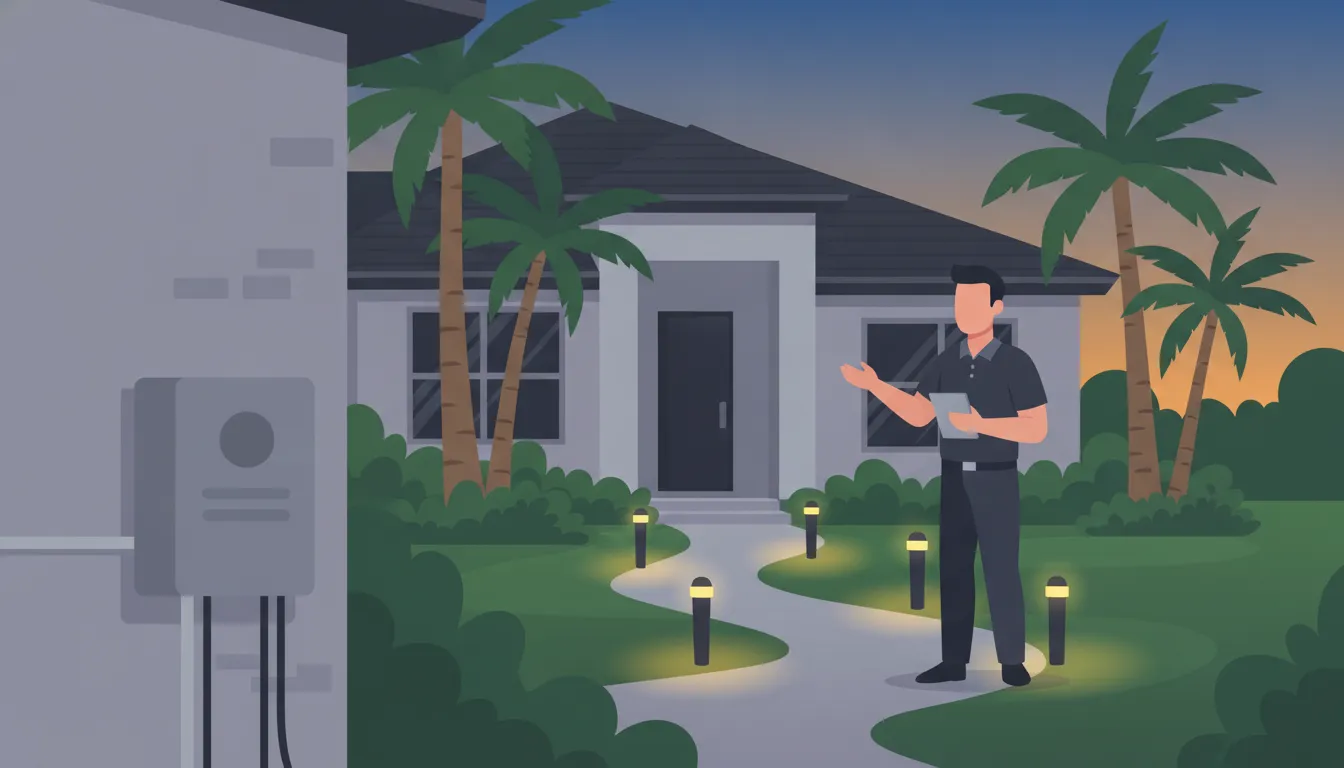
Dark walkways, harsh glare, and outdoor spaces that disappear after sunset can make a Florida home feel less comfortable than it should. A thoughtful lighting plan can improve visibility, highlight landscaping, and help your patio or entryway feel more usable. This guide explains low voltage lighting installation, including planning, safety, cost factors, and when to call an electrician.
Schedule Service for professional outdoor lighting installation in your area.
Low voltage lighting installation uses a transformer to reduce household power to a lower operating voltage for outdoor fixtures. The system still needs careful planning, weather-aware connections, proper load sizing, and safe wiring. My Electrician FL helps homeowners balance useful light where people walk with softer illumination where they want to create atmosphere.
What Is Low Voltage Lighting Installation?
Low voltage lighting is an outdoor lighting system that uses a transformer to reduce typical household electricity to a lower voltage for landscape fixtures. A transformer receives power from a household circuit. It steps the power down and sends it through outdoor cable to fixtures around paths, planting beds, trees, steps, walls, driveways, and patios. The basic concept is simple, but reliable results depend on a sound layout, suitable materials, and secure connections.
What parts make up the system?
- Transformer: This is the control point that steps down household power and distributes it to the lighting circuit. Many systems also use a timer, photocell, or smart control.
- Fixtures: Path lights, spotlights, well lights, step lights, and downlights each direct illumination differently. A path light supports visibility, while an adjustable spotlight can highlight a tree or architectural detail.
- Low voltage cable: The cable carries power from the transformer to each fixture. Longer runs and larger loads require planning so fixtures do not become noticeably dimmer farther from the transformer.
- Connectors: Outdoor connections need protection from moisture, corrosion, irrigation, and soil conditions. Weather-resistant connectors can reduce premature failures.
Low voltage lighting installation can improve visibility, comfort, and nighttime curb appeal without flooding the entire yard with glare. LED fixtures are widely used because they generally use less energy than incandescent lighting. Even though the fixture circuit operates at lower voltage, the transformer connects to household electricity. Proper placement, cable routing, load planning, and weather protection still matter.
Is Low Voltage Lighting Worth It for a Florida Home?
For many Florida homeowners, low voltage landscape lighting is worth considering when the goal is to make outdoor spaces safer, more comfortable, and more useful after sunset. It can softly define walkways, steps, patios, driveways, planting beds, and architectural features. It can also make an entry easier to see without the harsh glare that comes from poorly aimed floodlights.
- Better visibility: Path, step, and entry lighting can reduce dark areas where someone could trip or have difficulty seeing.
- More usable outdoor space: Thoughtful lighting can extend the time you comfortably use a porch, patio, or outdoor gathering area.
- Improved curb appeal: Well-aimed fixtures can highlight landscaping and the home's exterior while keeping the appearance subtle.
- Useful security visibility: Light near doors, gates, and walking routes can make activity easier to notice without leaving intense lights on everywhere.
- Flexible control: Timers and photocells can help the system operate when it is useful instead of remaining on all night.
The value depends on the design. A few carefully placed fixtures may work better than many bright fixtures installed without a plan. Florida heat, rain, irrigation, soil movement, salt air in coastal areas, damaged cable, loose connectors, and water entering a fixture can affect performance over time. The system is not maintenance-free. If you want practical options for your property, explore professional outdoor lighting installation.
How Do You Plan a Low Voltage Lighting Layout?
A useful layout starts with how you use the property after dark, not with a fixture catalog. Walk the yard at night and note where paths feel hard to see, steps need definition, entries need visibility, or planting beds disappear. Also identify areas where glare would be distracting.
- Set a goal for each area. Decide whether a light is meant to guide people, highlight landscaping, improve entry visibility, or create a welcoming setting. Separate essential lighting from decorative accents.
- Choose fixture types for the job. Path lights define walkways, while spotlights or flood-style fixtures can emphasize trees, walls, or architectural details. Use shielded or adjustable fixtures when possible to limit glare.
- Map placement and sightlines. Mark proposed locations on a simple property sketch, then view the plan from the driveway, walkways, windows, and seating areas. Avoid putting every fixture in a rigid line. Spacing depends on beam pattern, brightness, landscape features, and the home's layout.
- Size the transformer for the planned load. Add the wattage of the selected fixtures and allow room for connections and sensible future expansion. Controls should be included in the plan rather than added as an afterthought.
- Plan cable routes and connections. Trace the cable path from the transformer to each zone. Avoid areas likely to be disturbed by digging, irrigation work, or routine landscaping. Cable placement and protection requirements vary by location, so do not assume a depth found online applies universally.
- Test the design after sunset. Check for dark gaps, harsh glare, overlapping beams, uneven brightness, and light spilling into neighboring areas. Adjust fixture angles before finalizing the work. My Electrician's electrical services can help when the plan involves more than fixture placement.

Testing the layout after dark is important because a fixture can look balanced in daylight but create glare or dark gaps at night. Check the view from the front door, driveway, sidewalk, patio, and nearby windows. Small angle or spacing changes often improve the finished result more than simply adding brighter fixtures.
What Safety Steps Matter During Low Voltage Lighting Installation?
If path lights flicker, a transformer trips, or outdoor fixtures stop working after rain, the problem may involve more than a burned-out bulb. Water, damaged cable, poor connections, and an overloaded transformer can make a project unreliable or unsafe.
Start with a safe power source
Outdoor lighting should use an appropriate, protected power source. Never work on energized equipment in wet conditions. The CDC advises that electrical equipment exposed to water must be inspected and completely dry before it is returned to service. Read the CDC electrical hazard safety guidance.
Plan transformer placement and wiring
Keep the transformer accessible, protected from direct water exposure, and installed according to the manufacturer's instructions. Route cable so it is not likely to be cut by routine yard work. Use connections intended for outdoor conditions. A local electrician can evaluate the power source, route, load, and applicable requirements before installation.
Know when to stop
Frayed wiring, sparks, a burning odor, repeated breaker trips, or water inside electrical equipment are reasons to stop and seek qualified help. The CDC advises shutting off the electrical system at the main breaker if frayed wiring, sparks, or a burning odor appear. Do not turn power back on until the equipment has been inspected.
Permits and inspections may apply depending on the work and location. Washington L&I explains why electrical permits and inspections matter for safe, compliant work and property value in its electrical contractor guidance. Local requirements should be confirmed for your project. My Electrician serves homeowners from Palm Beach Gardens through Vero Beach with safety-focused electrical work.
How Much Does Low Voltage Lighting Installation Cost?
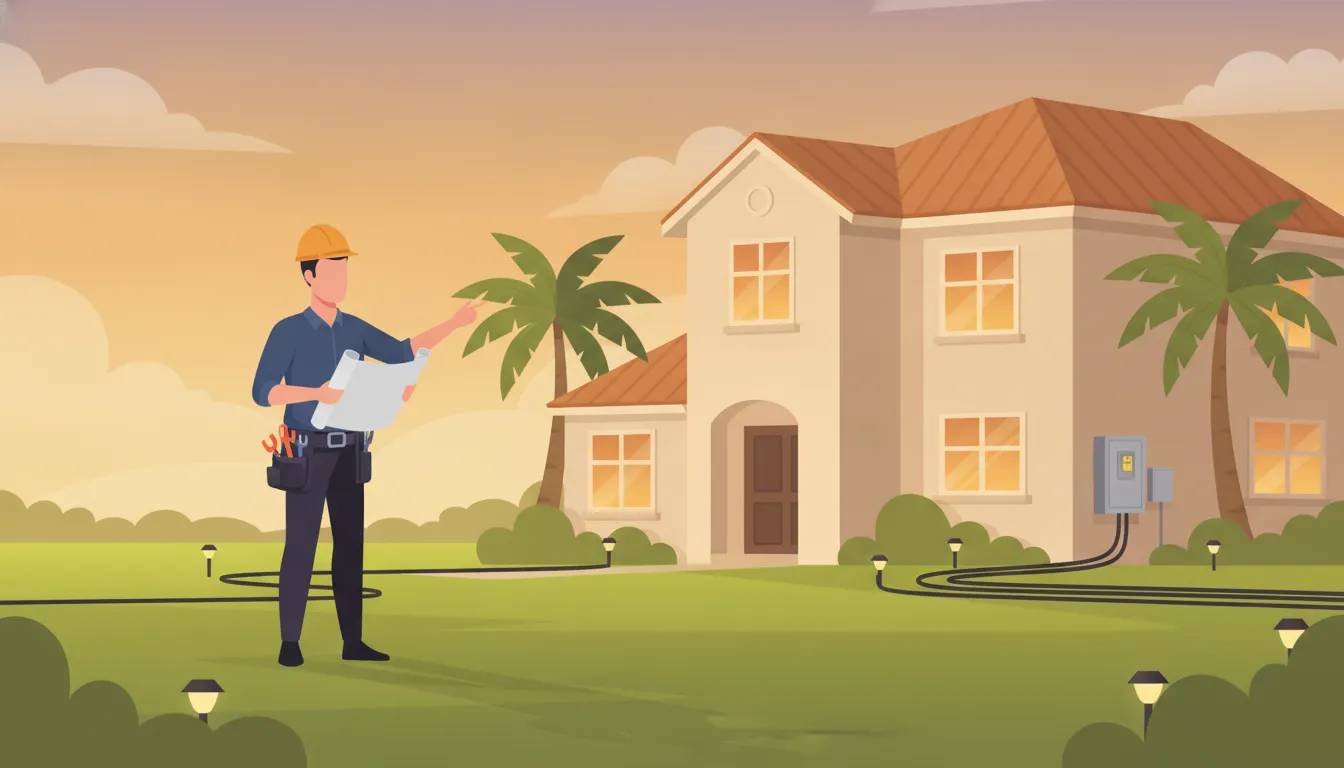
There is no responsible one-size-fits-all price for low voltage lighting installation. The cost depends on the property, the desired result, the number and type of fixtures, the transformer, cable runs, access, controls, and whether new electrical work is needed. A small repair is not the same project as a new system across a large yard.
| Cost factor | Why it matters |
|---|---|
| Fixture count and type | More fixtures increase materials, connections, and adjustment time. Specialty fixtures may cost more than basic path lights. |
| Transformer and load | The transformer must suit the planned load and any reasonable future expansion. |
| Cable length and routing | Longer runs, multiple zones, landscaping, irrigation, and access affect labor and materials. |
| Controls | Timers, photocells, and smart controls add capability and may change installation complexity. |
| Existing electrical conditions | A suitable outdoor power source may already exist, or the project may require additional electrical work. |
When comparing contractors, ask for written quotes that describe the same project. NC State contractor guidance recommends written quotes with enough detail to compare identical scopes. It also recommends putting the scope, materials, timing, and payment terms in writing. Read the NC State contractor selection guidance. A clear quote should identify fixture assumptions, transformer capacity, cable work, controls, testing, cleanup, and what happens if hidden conditions are found.
Schedule Service to discuss a lighting plan and receive a clear project scope.
Can You Install Low Voltage Lighting Yourself?
Homeowners can often plan goals, mark dark areas, compare fixture styles, and observe how a proposed layout looks after sunset. Those steps are useful. The electrical portion deserves more caution. Low voltage does not mean no risk because the transformer connects to household power and outdoor equipment faces rain, irrigation, heat, and soil movement.
Do not work on energized wiring. Do not use electrical tools or flip breakers while standing in water. If equipment has been wet, leave it off and arrange an inspection. A homeowner who sees sparks, frayed cable, a burning smell, repeated trips, or unexplained flickering should stop rather than keep replacing parts.
Professional help is especially appropriate when the project needs a new outdoor outlet or circuit, the transformer location is unclear, the cable route crosses areas with irrigation or hardscape, the load is difficult to calculate, or local permit questions exist. An electrician can also diagnose a system that works at the transformer but becomes dim farther away, develops dark zones, or fails after storms.
If you compare DIY kits, treat manufacturer instructions as project-specific guidance, not a substitute for local requirements. Ask how the system will be protected, how connections will be kept dry, how future fixtures will affect capacity, and how repairs will be handled. A careful installation should be easy to understand and maintain after the installer leaves.
When Should You Call an Electrician for Outdoor Lighting?
Call an electrician when you need a new installation designed, an outdoor power source added, or an existing system diagnosed. You should also seek help when the homeowner symptom is not clearly a simple lamp replacement.
- New installation: You want path, step, patio, driveway, or landscape lighting and need help with layout, load, transformer selection, or cable routing.
- Flickering or dim zones: Fixtures change brightness, sections fail, or lights become dim farther from the transformer.
- Repeated trips: A breaker or transformer protection trips more than once, especially after rain.
- Damage: Cable has been cut, fixtures are loose, connectors are corroded, or irrigation has disturbed the system.
- Water exposure: A fixture, outlet, or transformer has been flooded or soaked.
- Warning signs: You notice sparks, frayed wires, heat, or a burning smell.
- Project uncertainty: You are unsure whether permits, inspections, or a new circuit are needed.
For an existing system, lighting repair services may be the right starting point. For a new project, review electrical services and contact My Electrician to discuss the property. The company serves the Treasure Coast and Palm Beaches, including Port St. Lucie, Stuart, Jupiter, Fort Pierce, and Vero Beach.
Schedule Service before outdoor lighting problems leave your paths, steps, or entry areas dark.
Frequently Asked Questions
Is low voltage lighting worth it?
It can be worth it when you want better pathway visibility, more comfortable outdoor living, subtle curb appeal, or useful entry lighting. The result depends on layout, fixture quality, load planning, weather protection, and maintenance rather than voltage alone.
How deep should low voltage lighting wire be buried?
Burial depth depends on the cable, location, installation method, and applicable local requirements. Do not treat a generic online number as universal. Confirm the route and protection requirements with the manufacturer and a qualified electrician before digging.
Can I install low voltage lighting myself?
You may be able to plan a layout and compare fixtures yourself, but transformer work, outdoor power, buried cable, wet equipment, and permit questions deserve professional care. Stop if you see sparks, damaged wiring, water exposure, or a burning odor.
What is the benefit of low voltage landscape lighting?
Low voltage landscape lighting can define paths, improve visibility near steps and entries, add comfort to patios, and highlight landscaping with controlled illumination. A well-planned system avoids glare and leaves room for practical maintenance.
What should a lighting installation quote include?
Ask for the fixture types and count, transformer assumptions, cable routes, controls, electrical work, testing, cleanup, warranty terms, and payment schedule. Comparing written scopes makes it easier to understand why two proposals differ.
Schedule Service for Low Voltage Lighting Installation
The best outdoor lighting plan fits your property, your evening routines, and the conditions around your home. If you are planning a new system or troubleshooting dark, flickering, or damaged fixtures, My Electrician can help you choose a safe next step.
For broader room-by-room guidance, compare fixture placement and electrical planning in this lighting installation guide for Treasure Coast homes.