
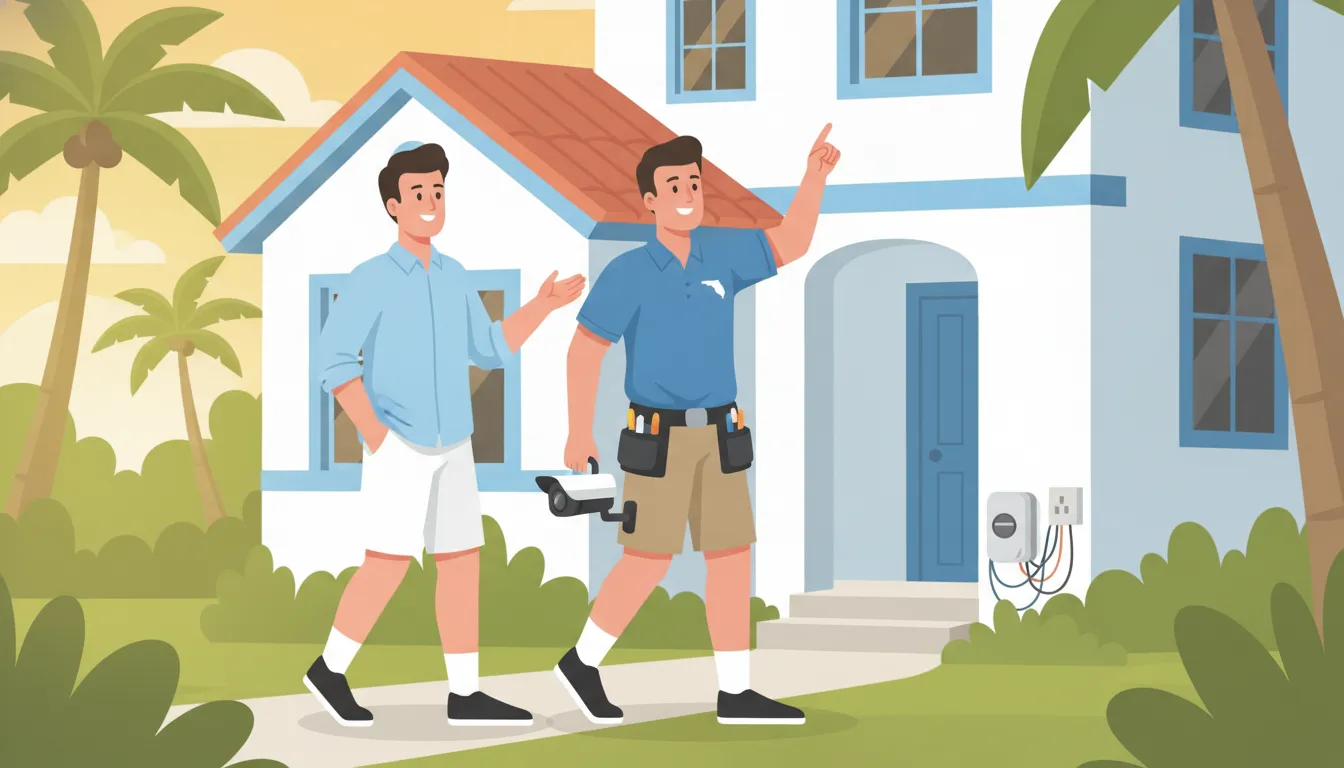
A camera can help you see who is approaching the front door, check a side gate, or keep an eye on a driveway while you are away. In a Florida home, however, a clear view is only part of the planning. Heat, humidity, salt air, heavy rain, storm exposure, power, and Wi-Fi all affect how a system should fit your property.
Good security camera installation starts by choosing the areas you need to monitor. Then confirming camera placement, power, connectivity, storage, privacy, and outdoor protection before any equipment is mounted. The FTC also recommends researching security features, including encryption for account information, live video, and archived recordings: FTC camera security guidance.
The right plan depends on your home's entrances, layout, network coverage, and exposure to Florida weather. It also helps separate camera and networking decisions from electrical wiring questions that may require professional attention. Start by considering the practical details that determine what your cameras need to cover and how they will be powered.
Schedule Service for security camera installation wiring and electrical planning.
What Should You Plan Before Security Camera Installation?
Start with the problem you want the system to solve. Do you want to see who is at the front door, check on vehicles in the driveway, monitor a rear entrance, or review footage after an incident? There is no single camera setup that works for every household, so planning around your property and daily routine is more useful than choosing a camera count first.
For many homeowners, the most important cameras cover key entry points and areas of concern. If you usually review recordings after an event rather than watching live video, prioritize the locations that provide useful evidence. Placement guidance from Belmont's police department recommends giving camera placement careful consideration and focusing on important entry points for this type of use.
- List the areas you want to see. Consider the front door, rear entrance, side gate, driveway, garage approach, and any other location where people or vehicles enter. A rear entrance may be covered from outside with a wider view or from inside with a camera facing the door.
- Sketch viewing angles before mounting anything. Note walls, rooflines, trees, fences, bright lights, and other obstructions. A wide view may show more of the property, while a narrower view may provide more useful detail at a specific entry point. A front-door camera near head height can improve the chance of identifying someone after an event, but the final position must also account for weather, tampering, and privacy.
- Match the equipment to the location. Outdoor locations may require an outdoor-rated, vandal-resistant camera. Infrared lighting can add detail in darkness. Florida homeowners should also think about humidity, salt air, heavy rain, and thunderstorms when planning outdoor power and equipment protection.
- Plan power and connectivity. Identify whether each camera will need an existing receptacle, a new power route, or another approved connection. Most cameras connect to home Wi-Fi, so check signal strength where each camera will operate. If the signal is weak, the installation plan may need to address the network rather than simply adding another camera.
- Decide how footage should be accessed and stored. Remote access can let you check the property while away and receive motion or sound alerts. Storage should cover more than a convenient single day when possible. One police guide identifies 24 hours as a minimum and suggests retaining footage for the usual length of a vacation or trip.
Household needs matter as much as property layout. Families may want coverage that avoids private areas, while seasonal residents may place greater value on remote access and longer storage. If the plan requires new wiring, exterior electrical work, or a code review, discuss those needs with a qualified electrician. My Electrician documents residential electrical and security-system wiring services, but does not claim to select, configure, or monitor camera equipment. You can review its residential electrical services when electrical planning is part of the project.
Where Should Cameras Go Around a Florida Home?
Start with the places where someone is most likely to approach, enter, or move around your property. For many homeowners, that means the front door, rear entrance, driveway, and side gate. Camera placement should support a clear purpose, such as identifying a visitor, watching vehicles, or receiving an alert when someone enters a less visible area. There is no single layout that works for every household, so consider your lot, doors, fencing, lighting, and daily routines before choosing locations.
Prioritize doors and access points
A front-door camera deserves careful planning. A position near head height can provide a better chance of identifying a person after an event. But the view should still capture the approach to the door without pointing directly into a bright sky or porch light. If the camera is exposed to rain, humidity, or accidental contact, select an outdoor-rated, vandal-resistant design. Built-in infrared lighting may provide more detail after dark, although nearby lights can create glare or wash out faces.
The rear entrance may need an exterior camera with a wider field of view, especially when it also covers part of the backyard. An interior camera aimed toward the rear door can be another option when outdoor wiring or weather exposure makes an exterior location impractical. A side gate is often a lower-priority location, but it can still function as an access-control point when the gate provides a route toward the home.
Cover the driveway without losing useful detail
Driveway cameras are primarily useful for watching vehicles and the route toward the garage or front of the home. A higher mounting position can provide a broader view, but higher is not always better. If the camera is too distant or angled too steeply, faces and package details may be difficult to identify. Test the intended view at different times of day, including when the sun is low, and account for headlights, reflective surfaces, palm fronds, and storm-driven rain.
Respect privacy boundaries
Keep the view focused on your property and necessary approaches. Avoid aiming into bedrooms, bathrooms, neighboring windows, or a fenced area where people may reasonably expect privacy. A Connecticut legislative research report is a useful example of why local privacy rules matter, but it is not Florida law. The report distinguishes areas in plain view from more private settings, including a fenced backyard, under that state's legal discussion. Before finalizing a view that captures neighbors or shared spaces, review applicable Florida and local requirements or ask qualified legal counsel.
Thoughtful placement also works with lighting. If you are improving visibility around entries, see these Florida outdoor security lighting considerations alongside the camera plan.
Wired or Wireless Security Cameras: Which Fits Your Home?
The right choice depends less on whether one format is universally better and more on how your household uses the cameras. A wireless camera may suit a finished home where you want a simpler installation and flexible placement. A wired system may make more sense when you want dependable power at fixed locations or when Wi-Fi coverage is inconsistent. There is no single camera solution that works for every household, so consider both the electrical layout and the way you expect to view and store footage.
| Consideration | Wired cameras | Wireless cameras |
|---|---|---|
| Power | Uses a fixed electrical connection, which can be practical for permanent locations but may require planned wiring. | May simplify placement, but the specific power method and maintenance needs depend on the equipment selected. |
| Connectivity | Can reduce dependence on a camera's Wi-Fi connection, although the complete system design still matters. | Typically depends on the home's wireless network. The FTC notes that most cameras connect to home Wi-Fi. |
| Installation complexity | Best planned before walls, ceilings, or exterior finishes are changed. Existing access and outdoor conditions affect the work. | Often offers more placement flexibility, but power access and reliable network reach still need attention. |
| Remote access | Both approaches may support remote viewing and motion or sound alerts when the selected system and network are configured for those functions. |
When a wired setup may be the better fit
Fixed cameras can be worth considering for a front entry, driveway, rear door, or other location you want covered continuously. If the home has weak wireless coverage in an exterior area, relying on Wi-Fi may create an avoidable connectivity concern. Wired installation can also be easier to plan during remodeling, when routes for power and low-voltage security wiring are more accessible. Outdoor connections need particular care in Florida, where humidity, heavy rain, storms, and salt air can affect exposed equipment and connections.
When wireless may fit better
Wireless cameras can be convenient for renters, finished homes, or households that want to adjust camera locations without opening walls. The tradeoff is that convenience does not remove the need for network planning. The FTC recommends a strong router password, an enabled router firewall, current router software, and WPA3 or WPA2 encryption. A separate network for cameras can also limit their access if another device or the main network is compromised. Remote access is useful for checking the home while away and receiving alerts, but storage planning matters too. One police guide recommends keeping at least 24 hours of footage and matching storage to the length of a typical trip.
Before choosing, map the locations, identify available power, check likely Wi-Fi coverage, and decide how long footage should remain available. My Electrician can address documented electrical and security-system wiring needs, but camera brand selection, networking, configuration, and monitoring should be confirmed with the equipment provider.
How Can You Protect Camera Power and Privacy in Florida?
Florida conditions make both camera power and digital privacy worth planning before security camera installation. Coastal humidity, salt air, frequent thunderstorms, and sudden heavy rain can stress outdoor equipment and its connections. Monroe County notes that coastal thunderstorms are frequent and can produce several inches of rain in less than an hour. That makes weather-rated equipment, protected connections, and professional electrical guidance especially important for exterior cameras.
Protect outdoor power from weather and surges
Do not assume that a connector is safe simply because it is labeled weatherproof. The U.S. Consumer Product Safety Commission reported that water entered a weatherproof connector on a recalled outdoor-camera power adapter. The water could cause a short circuit, melting, and overheating that created a fire hazard. Check manufacturer recall information and stop using any recalled adapter as directed by the CPSC. Avoid improvising outdoor wiring or opening electrical equipment yourself. A qualified electrician can evaluate the power source, routing, protection, and code considerations for the installation.
Storm planning matters too. Monroe County recommends protecting belongings from power surges during thunderstorms. Ask a professional whether layered or whole-home surge protection is appropriate for your electrical system, particularly if cameras, networking equipment, or recording devices are important to your household. For broader guidance on outdoor connections and storm preparation, review these Florida electrical safety tips.
Keep video accounts and home networks private
The FTC warns that internet-connected security cameras can be hacked. Before choosing a camera, research its privacy and security features. Look for encryption that protects account information, live streams, and archived video. Most cameras connect through home Wi-Fi, so secure the router with a strong, unique password, an enabled firewall, current software, and WPA3 or WPA2 wireless encryption. Change default administrative credentials and the network name, and avoid using your name, address, or router brand in login details.
A separate network for cameras can limit access if another device or the main network is compromised. Keep camera software, router software, and the viewing app updated, using automatic updates when available. Finally, confirm that the camera requires a password and review the management app's privacy settings and permissions. Aim cameras only at areas you have a legitimate reason to monitor, and avoid private spaces or neighboring property. Privacy rules can vary, so check applicable Florida guidance when your placement could affect others.
When Should an Electrician Help With Camera Wiring?
A security camera can be easy to mount, but the electrical side deserves more care when a project involves a new circuit. An exterior power source, or wiring that passes through walls. My Electrician, Inc. is documented for residential and commercial electrical installation, including security system wiring. Camera selection, app configuration, monitoring, and system guarantees are outside the specific service facts available for this article, so confirm those responsibilities with your camera provider.
Consider professional electrical help when:
- The camera needs a new power point. Adding an outlet, hardwired connection, or dedicated circuit is not the place for guesswork. A qualified electrician can evaluate the existing circuit and plan the work around safety requirements.
- The route crosses an exterior wall or roofline. Penetrations need to be planned so water does not enter the structure. Outdoor components and connections also need to match the exposure at the installation location.
- The home has older wiring or repeated electrical symptoms. Flickering lights, warm outlets, burning odors, buzzing, or breakers that trip should be addressed before adding another connected device.
- You are unsure about local requirements. Electrical work should account for the National Electrical Code, applicable local codes, manufacturer specifications, and safety practices. Ask questions before work begins rather than trying to correct an unsafe installation later.
- You want the existing system reviewed first. A professional electrical safety inspection can help identify concerns with panels, wiring, outlets, and protective devices before a camera project adds demand.
For a homeowner, the safest handoff is simple: describe where you want coverage. Show the proposed camera and power locations, and explain whether the system will be indoors, outdoors, or exposed to storms. The electrician can focus on the electrical path and safety questions, while the camera or security-system provider handles equipment-specific setup when that service is included.
My Electrician serves homeowners across the Treasure Coast and Palm Beaches, with Port St. Lucie as its headquarters. If your plan involves electrical work, review the company's residential electrical services and ask for a clear scope before work begins.
Schedule Service to discuss your security camera installation plan.
Frequently Asked Questions
How much does it cost to install security cameras?
The cost depends on the number of cameras, their locations, the power and data path available, outdoor wiring conditions, storage preferences, and whether new electrical work is needed. A home with accessible power near each camera may require a different scope than one needing concealed wiring, weather-resistant connections, or additional network planning. An electrician can review the property and provide a quote based on the actual installation conditions rather than a generic price.
Can I install home security cameras myself?
You may be able to handle basic placement and app setup, but do not improvise electrical connections or outdoor wiring. Get professional help when installation requires new power, work near energized equipment, penetration of exterior walls, or connections exposed to rain and humidity. Keep the camera system within its intended use, follow the manufacturer instructions, and ask an electrician about wiring that needs to be safe, protected, and code-conscious.
Where should you avoid placing security cameras?
Avoid aiming cameras into bedrooms, bathrooms, neighboring private areas, or anywhere people reasonably expect privacy. Frame outdoor cameras toward your own entrances, gates, driveway, and other areas you need to monitor, while limiting views beyond your property. Privacy rules can vary by location, so review applicable Florida requirements and discuss uncertain placements before installation.
How does a wireless security camera get power?
Wireless usually describes the network connection, not necessarily the power source. Depending on the model, a camera may use a battery, a plug-in adapter, or wiring connected to an electrical source. Confirm the power method before choosing a location. Outdoor adapters and connections must be protected from moisture, and storm exposure should be considered in Florida homes.
How can I keep connected cameras private?
Choose a camera with appropriate encryption, use a strong router password, keep the router and camera app updated, and review app permissions. The FTC recommends researching security features and securing the Wi-Fi network because many cameras connect through it.
Schedule Service for Camera Wiring Questions
Professional planning can help identify the electrical work, power needs, and outdoor wiring considerations that fit your home before installation begins. My Electrician can discuss electrical or security-system wiring questions and help you determine an appropriate next step.
Call My Electrician FL at 877-762-7483 to schedule security camera installation wiring service.